
Commercial Dishwasher Descaling Guide
Scale Building Up in Your Commercial Dishwasher? Find the Cause Before You Treat It.
White deposits around the tank.
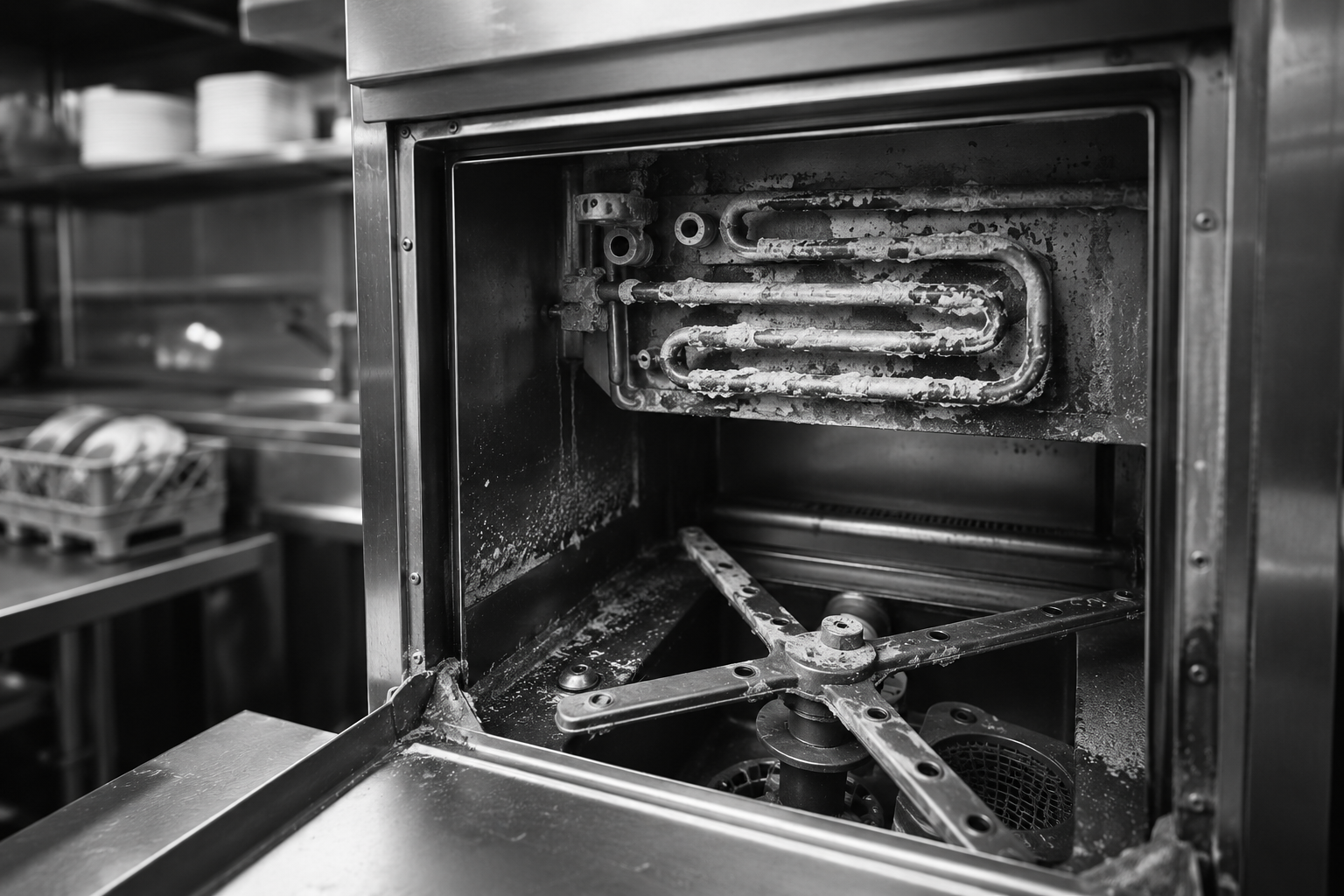
Scale forming on heating components.
Rinse jets beginning to block.
Glasses or dishes no longer coming out as clean as they once did.
When mineral deposits start appearing inside a commercial dishwasher, descaling may be necessary — but simply removing the scale isn't always the complete solution.
If you don't understand why the deposits are forming, they may simply return.
Worldwide CDM helps Sydney restaurants, cafés, clubs, hotels, hospitals and commercial kitchens identify commercial dishwasher scale problems, water-treatment issues and related equipment faults.
Keep Serving Customers With Confidence.
What Is Commercial Dishwasher Scale?
Scale is the hard mineral deposit that can develop when water containing dissolved minerals is repeatedly heated.
Water hardness is primarily associated with dissolved calcium and magnesium.
In commercial dishwashing equipment, repeated heating and water use can contribute to mineral deposits forming on surfaces and components.
Depending on the equipment and water conditions, scale may appear:
Inside the wash tank
Around heating elements
Inside or around booster systems
On wash and rinse arms
Around rinse jets
On internal surfaces
Within water pathways
On dishes and glassware
A small amount of visible scale doesn't automatically mean the dishwasher needs an aggressive descaling treatment.
The location, severity and underlying cause should be considered first.
What Is Commercial Dishwasher Descaling?
Descaling is the process of removing mineral deposits from appropriate components and surfaces of the dishwasher using a method suitable for the particular equipment.
The purpose is to remove accumulated scale that can interfere with normal equipment operation.
However, commercial dishwashers vary significantly between brands and models.
Materials, heating systems, pumps, seals, chemical systems and manufacturer procedures can differ.
There isn't one universal descaling procedure that's appropriate for every commercial dishwasher.
Always follow the manufacturer's instructions for the specific machine and any chemical being used.
Where significant scale, inaccessible deposits or equipment faults are involved, professional servicing may be the safer approach.
Does My Commercial Dishwasher Need Descaling?
Possible signs of scale accumulation can include:
Visible white or chalky deposits
Scale around heating elements
Deposits around rinse jets
Blocked or restricted spray openings
Mineral deposits inside the tank
Increasing heating or recovery time
Changes in rinse performance
White mineral deposits on ware
Repeated scale accumulation after cleaning
But these symptoms don't automatically mean descaling is the only solution.
For example, white marks on dishes can also involve chemical dosing or rinse-performance problems.
Poor heating can involve elements, thermostats, sensors, contactors, relays or other electrical faults.
Poor rinsing can involve blocked jets, water supply, booster operation or other rinse-system problems.
Diagnose the problem before assuming scale explains everything.
Why Does Scale Build Up in a Commercial Dishwasher?
Scale accumulation can be influenced by several factors, including:
Incoming water hardness
Water temperature
Water-treatment effectiveness
Dishwasher usage
Water consumption
Water-softener operation
Regeneration frequency
Salt availability
Equipment condition
Maintenance practices
A heavily used commercial dishwasher can process substantial quantities of water.
Where the incoming water contains significant hardness minerals and treatment isn't adequately controlling them, deposits can accumulate over time.
Hard Water and Commercial Dishwashers
Hard water isn't simply water that looks cloudy.
The term refers to water containing relatively high concentrations of dissolved calcium and magnesium ions.
When water is heated, mineral deposits can form.
In a commercial dishwasher, that matters because some of the most important components operate in heated, water-carrying systems.
Scale isn't therefore purely cosmetic.
Depending on its severity and location, it can affect equipment performance.
How Scale Can Affect Commercial Dishwasher Heating
One area where scale can become particularly important is the heating system.
Mineral deposits can accumulate on heating surfaces.
Scale can act as an insulating layer, reducing efficient heat transfer between the heating surface and the surrounding water.
Depending on the machine and severity of the accumulation, this can contribute to:
Longer heating times
Slower temperature recovery
Reduced heating efficiency
Additional stress on heating systems
If your dishwasher has started taking longer to heat and significant scale is visible, both symptoms should be investigated.
Don't automatically assume the heating element has failed.
Scale Around Commercial Dishwasher Rinse Jets
Rinse jets need clear water pathways to distribute water correctly.
Mineral deposits around small openings can restrict water flow and alter spray patterns.
This may contribute to:
Uneven rinsing
Poor rinse coverage
Reduced rinse performance
Marks remaining on ware
Blocked rinse jets
Removing a visible obstruction may restore the opening, but if scale quickly returns, the underlying water conditions should also be considered.
Scale Around Wash Arms and Jets
Wash performance depends on effective water circulation and distribution.
Depending on the machine, mineral accumulation can develop around:
Wash-arm openings
Jets
Internal water passages
Connections
Restrictions can interfere with normal water distribution.
However, food debris and other contamination can also block wash components.
Before blaming scale, establish what's actually causing the restriction.
Scale and Commercial Dishwasher Booster Systems
Many commercial dishwashing systems use a booster to achieve the required rinse-water conditions for their design and application.
Where scale accumulates on water-heating surfaces or within associated water pathways, heating and flow can potentially be affected.
Because these systems can involve high temperatures, electrical components and pressurised or heated water, internal servicing isn't an appropriate DIY task for untrained kitchen staff.
Commercial Dishwasher Descaling vs Daily Cleaning
These are not the same thing.
Daily Cleaning
Routine operator cleaning generally focuses on removing:
Food debris
Grease
Residue
Contamination
and keeping operator-serviceable parts clean.
Depending on manufacturer instructions, this can include cleaning filters, strainers, wash arms and the wash chamber.
Descaling
Descaling specifically addresses mineral deposits.
Cleaning detergent designed for food soil isn't necessarily a descaler.
Likewise, a descaling chemical isn't simply a stronger version of everyday dishwasher detergent.
Use the correct process for the problem you're actually trying to solve.
Should You Descale a Commercial Dishwasher Yourself?
This depends on the particular dishwasher and its manufacturer's instructions.
If the manufacturer provides an approved operator descaling procedure, trained staff may be able to perform that procedure using the specified product and process.
However, you shouldn't improvise.
Commercial dishwashers can contain:
Stainless steel components
Different metal alloys
Rubber seals
Pumps
Heating elements
Sensors
Chemical dosing equipment
Electrical systems
Using an unsuitable chemical, concentration or procedure can potentially damage components or create a safety risk.
If you're unsure, don't guess. Check the manufacturer's instructions or arrange professional servicing.
Commercial Dishwasher Descaling Safety
Descaling products can be acidic and may present chemical hazards.
Any product should be used strictly according to its:
Manufacturer instructions
Safety Data Sheet
Required concentration
Contact time
Personal protective equipment requirements
Rinsing requirements
Equipment compatibility
Never mix cleaning chemicals unless the product manufacturer specifically instructs you to do so.
In particular, mixing incompatible cleaning chemicals can create dangerous reactions or gases.
Commercial Dishwasher Descaling: General Process
Because procedures differ between commercial dishwasher brands and models, this isn't a substitute for the manufacturer's instructions.
At a general level, an approved descaling procedure may involve:
1. Identify Whether Scale Is Actually Present
Look for mineral accumulation rather than assuming every white deposit is scale.
2. Check the Manufacturer's Instructions
Determine whether the machine has an approved descaling procedure and which products are compatible.
3. Prepare the Equipment Correctly
Follow the manufacturer's shutdown, draining and preparation instructions.
4. Use the Correct Descaling Product
Only use a product appropriate for the equipment and follow its stated concentration and safety requirements.
5. Follow the Specified Descaling Procedure
Contact time, circulation requirements and operating instructions can vary.
6. Drain and Rinse as Required
The machine needs to be appropriately rinsed according to the manufacturer's instructions before returning to normal food-service operation.
7. Investigate Why the Scale Formed
This is the step that is often forgotten.
Removing scale fixes the deposit. It doesn't necessarily fix the reason the deposit developed.
Don't Pour Random Descaler Into Your Dishwasher
More chemical does not mean better descaling.
A stronger concentration or longer exposure than recommended can potentially damage equipment.
Avoid using improvised acids, household products or unknown chemical combinations simply because they appear capable of dissolving mineral deposits.
Commercial equipment should be maintained using procedures and products compatible with that particular machine.
Why Does Scale Keep Coming Back?
If your dishwasher is repeatedly being descaled and heavy deposits keep returning, stop treating descaling as the entire solution.
Possible underlying factors can include:
Hard incoming water
Water softener not operating correctly
Incorrect softener regeneration
Insufficient salt where required
Incorrect water-treatment settings
High water consumption
Changes in water conditions
Inadequate maintenance
The dishwasher may be telling you there is a water-treatment problem upstream.
Commercial Dishwasher Water Softener and Scale Problems
Where a water softener is installed, its job is typically to reduce hardness before the water reaches the equipment.
Depending on the system, correct operation may rely on:
Ion-exchange resin
Salt
Brine
Regeneration cycles
Valves
Controls
Correct settings
If regeneration isn't occurring correctly, the softener has exhausted its capacity or another fault develops, hard water can begin reaching the dishwasher.
The result may be increasing scale even though a softener is installed.
Descaling Won't Repair a Faulty Water Softener
This distinction is important.
Imagine scale is building up because the water softener isn't regenerating correctly.
You descale the dishwasher.
The machine looks clean again.
But untreated hard water continues entering it.
Eventually the scale returns.
The descaling process worked.
It just didn't address the actual cause.
That's why recurring scale should prompt investigation of the wider water-treatment system.
How Can You Tell if Your Water Softener Is Working?
Depending on the installation, appropriate checks may involve assessing:
Incoming water hardness
Treated water hardness
Salt levels
Regeneration
Water usage
System settings
Visible scale accumulation
Water-hardness testing can be particularly useful because it provides evidence about whether the water is actually being softened.
A salt reservoir containing salt doesn't, by itself, prove the softener is working correctly.
Is Every White Deposit Scale?
No.
This is one of the most important distinctions on this page.
White residue can potentially involve:
Mineral deposits
Detergent residue
Rinse-aid issues
Chemical concentration
Food residue
Water-quality conditions
Poor rinsing
The appearance and location of the deposit matter.
If dishes are covered in white marks but the machine itself has little mineral accumulation, don't automatically reach for descaler.
The problem may be elsewhere.
Cloudy Glasses After Dishwashing
Cloudy glasses can also be mistaken for a straightforward scale problem.
Possible factors include:
Mineral deposits
Water hardness
Detergent conditions
Rinse-aid delivery
Rinse temperature
Rinse performance
Glass condition or permanent etching
Some deposits may be removable.
Permanent glass damage may not be.
If glassware has suddenly changed appearance, investigate what has changed in the washing, rinsing, chemical or water-treatment process.
Can Scale Cause a Dishwasher to Take Longer to Heat?
Significant scale on heating surfaces can reduce heat-transfer efficiency.
However, slow heating can also result from faults involving:
Heating elements
Thermostats
Temperature sensors
Contactors
Relays
Electrical supply
Booster components
or associated controls.
If a dishwasher is taking too long to heat, don't replace a heating element or descale the machine based on assumption alone.
Find out what's actually causing the symptom.
Can Scale Cause Poor Rinsing?
Scale can contribute where mineral accumulation restricts rinse jets or water pathways.
But poor rinsing can also involve:
Blocked rinse arms
Water-supply problems
Rinse temperature
Booster problems
Chemical dosing
Valves
Water pressure or flow
Other machine-specific faults
Again, one symptom can have several possible causes.
How Often Should a Commercial Dishwasher Be Descaled?
There is no universal schedule that applies to every commercial dishwasher.
How quickly scale develops can depend on:
Water hardness
Water-treatment system
Dishwasher usage
Operating temperature
Manufacturer requirements
Maintenance history
Site conditions
A dishwasher supplied with appropriately treated water may have very different descaling requirements from a machine operating under harder-water conditions.
Descale according to actual need and manufacturer requirements — not simply because a calendar says it's time.
Does Every Commercial Dishwasher Need Regular Descaling?
No.
Commercial dishwashers shouldn't automatically receive unnecessary chemical treatment.
If scale isn't present and the manufacturer doesn't require a particular descaling procedure at that interval, there may be no reason to perform one.
Worldwide CDM's approach is simple:
Inspect first. Service what's required. Don't create unnecessary work.
When Should You Call a Commercial Dishwasher Technician?
Consider professional inspection if:
Heavy scale is present
Scale repeatedly returns
Heating performance has deteriorated
Rinse jets continually block
The dishwasher has a suspected water-softener problem
You aren't sure whether deposits are actually scale
Internal components require access
The machine is displaying faults
Electrical or heating components need testing
You're unsure of the correct descaling procedure
The dishwasher hasn't been professionally serviced for some time
Sometimes the correct solution is descaling.
Sometimes it isn't.
What Your Staff Can Do to Reduce Scale Problems
Kitchen staff can help by following the manufacturer's operating and cleaning procedures.
Where applicable:
Check water-softener salt levels
Complete required regeneration procedures
Keep filters and strainers clean
Clean operator-removable wash and rinse arms
Report new mineral deposits
Report changes in heating time
Report changes in wash or rinse performance
Use approved dishwasher chemicals correctly
Arrange servicing when equipment performance changes
One of the most useful things staff can do is notice change.
If a machine that was previously clean suddenly begins developing heavy scale, tell the technician.
A Descaling Service Shouldn't Become an Automatic Upsell
Descaling is useful when the equipment genuinely requires it.
It shouldn't simply be added to every service because it's another chargeable item.
If scale isn't present, unnecessary descaling doesn't improve the dishwasher simply because a chemical has been circulated through it.
If scale is present, the next question should be:
Why did it develop?
That's how you move from repeatedly treating symptoms to properly maintaining the equipment.
How Worldwide CDM Approaches Dishwasher Scale Problems
Your Kitchen Needs Reliable Equipment — Not Guesswork.
1. Tell Us What You're Seeing
Let us know the dishwasher brand, model and symptoms.
Tell us about:
Visible scale
White marks
Cloudy glasses
Slow heating
Poor rinsing
or repeated mineral accumulation.
2. We Assess the Dishwasher
Relevant systems can be inspected based on the machine and symptoms.
3. We Consider the Cause
Where appropriate, this can include the dishwasher, water hardness, water treatment, softener operation, heating, rinsing and chemical systems.
4. We Explain What Actually Requires Attention
If descaling is appropriate, we'll tell you.
If the problem is coming from somewhere else, we'll tell you that too.
5. We Help You Address the Underlying Problem
Because removing scale without addressing why it keeps forming may only provide a temporary result.
Find the cause. Treat what's required. Keep your equipment working properly.
Commercial Dishwasher Descaling & Servicing Sydney
Worldwide CDM provides commercial dishwasher servicing and fault diagnosis across Sydney for:
Restaurants
Cafés
Hotels
Pubs
Clubs
Hospitals and healthcare facilities
Catering operations
Commercial kitchens
We can investigate issues involving:
Scale build-up
Hard-water problems
Water softeners
Heating problems
Rinse problems
White marks on dishes
Cloudy glassware
Wash-performance problems
Routine servicing
Preventative maintenance
Commercial Dishwasher Brands We Repair
Worldwide CDM repairs and services many leading commercial dishwasher brands, including:
Don't see your dishwasher brand listed?
Our experienced technicians repair many other commercial dishwasher makes and models used throughout Sydney.
Why Choose Worldwide CDM?
We Find the Problem Before We Recommend the Fix.
Your kitchen doesn't benefit from paying for maintenance it doesn't need.
And repeatedly removing scale isn't particularly useful if nobody investigates why it keeps coming back.
Worldwide CDM provides:
✔ 30+ years supporting Sydney commercial kitchens
✔ Experienced commercial catering equipment technicians
✔ Commercial dishwasher servicing
✔ Commercial dishwasher fault diagnosis
✔ Scale and water-related problem investigation
✔ Water-softener problem diagnosis
✔ Preventative maintenance programs
✔ Repairs for leading commercial dishwasher brands
✔ Genuine spare parts
✔ Straightforward, honest advice
✔ Sydney-wide & Central Coast service
Keep Serving Customers With Confidence.
Click Here To Book A Service
Click Here To Call Us
Frequently Asked Questions
What is commercial dishwasher descaling?
Descaling is the removal of mineral deposits that have accumulated on appropriate surfaces or components within a commercial dishwasher.
What causes scale in a commercial dishwasher?
Scale is commonly associated with hardness minerals such as calcium and magnesium in the water. Water hardness, heating, water treatment, equipment usage and softener performance can influence accumulation.
How do I know if my commercial dishwasher needs descaling?
Visible chalky mineral deposits, scaling around heating surfaces or jets and recurring mineral accumulation can indicate that descaling may be appropriate. The machine should be assessed according to its condition and manufacturer requirements.
How often should a commercial dishwasher be descaled?
There is no universal interval. Water hardness, treatment, usage, manufacturer requirements and actual scale accumulation should determine when descaling is appropriate.
Can I descale a commercial dishwasher myself?
Only follow an operator descaling procedure if it is approved for your specific dishwasher and you can comply with the equipment and chemical manufacturer's instructions and safety requirements. Otherwise, arrange professional servicing.
Can I use vinegar to descale a commercial dishwasher?
Don't substitute household acids or improvised chemicals for an approved commercial dishwasher descaling procedure. Use products and procedures compatible with the particular equipment and follow manufacturer instructions.
Can scale damage a commercial dishwasher?
Significant mineral accumulation can interfere with heating surfaces, jets and water pathways and may contribute to performance or component problems depending on where and how severely it develops.
Why does my commercial dishwasher keep scaling up?
Recurring scale may indicate that hard water continues to reach the dishwasher. Water hardness, softener operation, regeneration, salt supply and other water-treatment factors may need investigation.
Will descaling fix cloudy glasses?
Only if removable mineral deposits are actually responsible. Cloudy glassware can also involve chemical dosing, rinsing, wash conditions or permanent glass damage.
Will descaling fix white marks on dishes?
Not necessarily. White marks can have several causes, including mineral deposits, chemicals and rinse-performance problems.
Does descaling fix a water softener?
No. Descaling removes mineral accumulation from appropriate dishwasher components. It doesn't repair a water softener that isn't operating correctly.
Can scale make a commercial dishwasher heat slowly?
Significant scale on heating surfaces can reduce heat transfer, but slow heating can also result from electrical, heating-element, thermostat, sensor or other equipment faults.
Do you provide commercial dishwasher descaling in Sydney?
Worldwide CDM can assess commercial dishwasher scale problems as part of dishwasher servicing and determine whether descaling, water-treatment attention or another repair is appropriate.
Scale Keeps Coming Back?
Don't Just Remove It. Find Out Why It's There.
Descaling may clean the machine today.
But if the underlying water or equipment problem remains, the scale can return.
Worldwide CDM can assess the dishwasher, investigate what's contributing to the build-up and recommend the maintenance or repair that's actually required.
We Find the Fault Before We Sell the Fix.
Keep Serving Customers With Confidence.
Related Commercial Catering Equipment Repairs
Worldwide CDM also provides professional repairs for: