
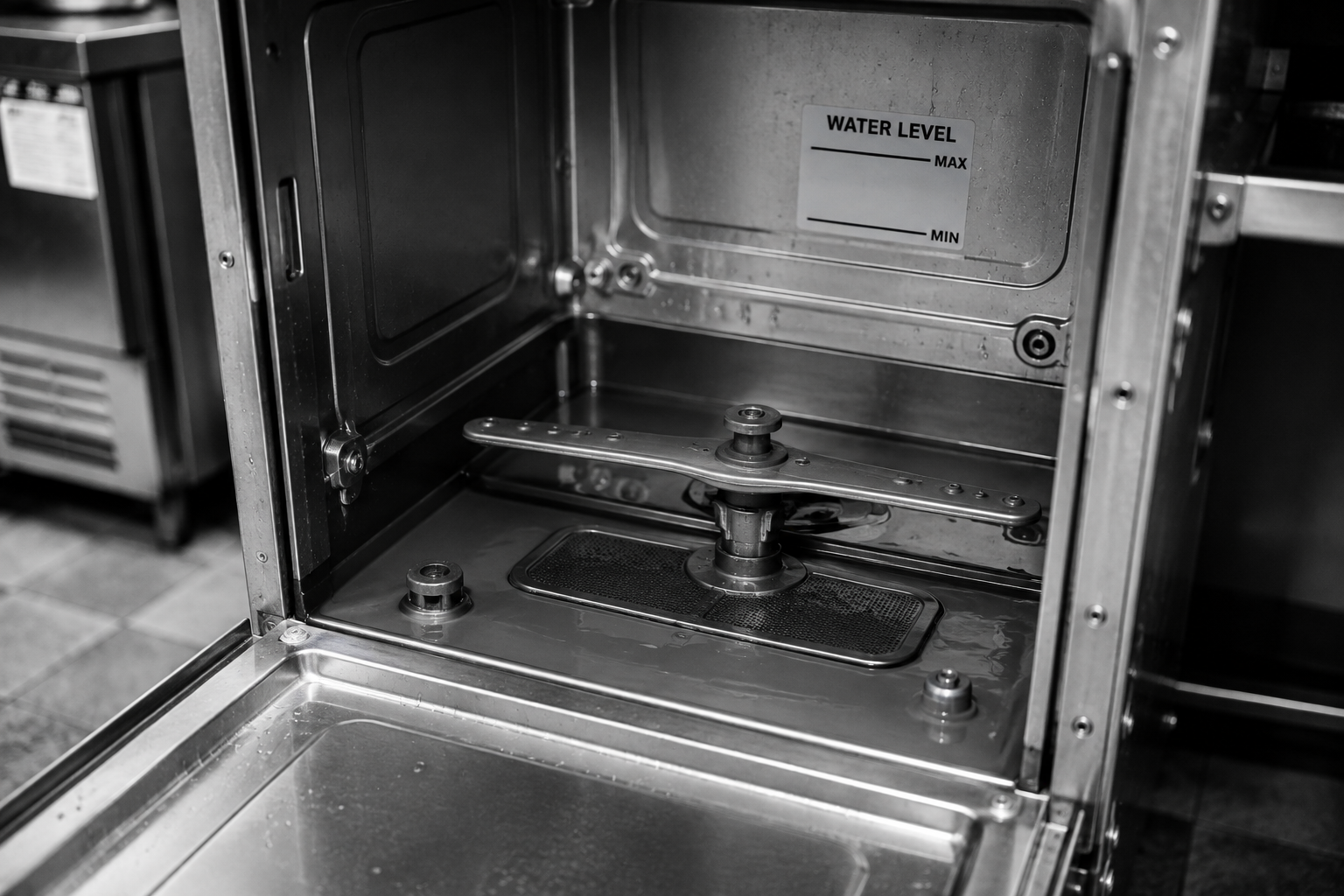
Commercial Dishwasher Low Water Level Problems
Not Enough Water? Get Your Dishwasher Washing Properly Again.
Your commercial dishwasher may still turn on and complete a cycle — but that doesn't necessarily mean it's operating correctly.
If the water level inside your commercial dishwasher is too low, the wash system may not have enough water available to circulate correctly. The result can be poor washing performance, unusual pump noise, inconsistent results or dishes coming out dirty.
For a busy restaurant, café, club, hotel, hospital or commercial kitchen, unreliable warewashing can quickly interfere with service.
Worldwide CDM provides professional commercial dishwasher repairs across Sydney, diagnosing low water level, filling and wash-system problems to identify what's actually causing the fault.
Keep Serving Customers With Confidence.
What Does Low Water Level Mean in a Commercial Dishwasher?
A commercial dishwasher is designed to operate with a specified amount of water in its wash tank or sump.
The exact water level and the method used to control it vary by manufacturer and model.
A low-water problem occurs when the machine doesn't establish or maintain the operating water level required by its design.
This is different from a dishwasher that doesn't fill at all.
A machine with low water may:
Fill partially
Start its wash cycle
Appear to operate normally
Still circulate some water
Yet the amount of water available to the wash system may be insufficient.
That's why low water level can sometimes first appear to the operator as a poor washing problem rather than a filling problem.
Signs Your Commercial Dishwasher May Have a Low Water Level
The symptoms vary depending on the dishwasher and the underlying fault, but you may notice:
Dishes aren't being cleaned properly
Food residue remains after the wash
Wash action appears weaker than normal
Unusual noise from the wash pump
The machine takes longer than expected to establish its operating level
Water level appears visibly lower than normal
Intermittent filling problems
A filling or water-related error code appears
The machine fills but doesn't appear to have enough water for normal washing
These symptoms don't prove the machine has a low-water fault. For example, poor washing can also result from blocked wash arms, wash-pump problems, loading practices, temperature or chemical issues.
The fault needs to be diagnosed rather than assumed.
Why Is My Commercial Dishwasher Water Level Too Low?
There isn't one universal cause.
The filling system differs between commercial dishwasher manufacturers and models, but several areas may need to be investigated.
1. Restricted Water Supply
The dishwasher needs an adequate incoming water supply to fill as designed.
Problems upstream of the machine may affect filling performance.
Depending on the installation, a technician may need to consider the incoming water supply and whether it meets the requirements specified for that particular dishwasher.
This is an important distinction:
A low-water problem isn't always caused by a faulty component inside the dishwasher.
The machine's installation and water supply can also matter.
2. Water Inlet Valve Problems
Commercial dishwashers commonly use an electrically controlled inlet valve to control water entering the machine.
If the valve isn't opening or flowing correctly, the dishwasher may not receive water as intended.
However, seeing a low water level doesn't automatically mean:
"Replace the inlet valve."
The technician should determine whether the valve is actually receiving the correct control signal and whether another part of the filling system is responsible.
3. Blocked or Restricted Inlet Components
Restrictions in the water supply path can reduce the amount or rate of water entering the dishwasher.
Depending on the particular machine and installation, this may involve components associated with the inlet-water system.
Scale, debris or other restrictions should therefore be considered where appropriate.
This can be particularly relevant in commercial equipment because high usage means relatively small performance problems can become noticeable during repeated daily cycles.
4. Water-Level Sensor or Level-Control Problems
A commercial dishwasher needs some way of determining when the correct water level has been reached.
The method varies considerably between machines.
Depending on the dishwasher, water-level control may involve components such as:
Pressure switches
Pressure chambers
Level sensors
Probes
Electronic controls
or another manufacturer-specific system.
If that system doesn't correctly detect or control the water level, the machine's filling sequence can be affected.
That's one reason technicians need the brand and model number when diagnosing a low-water problem.
5. Pressure Switch or Pressure-System Problems
Some commercial dishwashers use changes in air pressure as part of their water-level detection system.
Where this type of system is fitted, diagnosis may need to consider more than the pressure switch itself.
Associated tubing or a pressure chamber can potentially become restricted or contaminated and interfere with accurate water-level detection.
Replacing a pressure switch without diagnosing the complete system may therefore fail to correct the problem.
That is why Worldwide CDM's approach is to identify the fault before recommending parts.
6. Drainage or Water Retention Problems
A filling complaint isn't always isolated to the inlet side of the machine.
Depending on the dishwasher's design and where in the cycle the symptom occurs, the technician may also need to consider whether water is being retained and discharged as intended.
The filling and drainage sequences work together as part of the machine's operating cycle.
This is particularly important if the customer reports that the water level changes unexpectedly rather than simply being low from the beginning.
7. Control or Electrical Problems
Modern commercial dishwashers use timers, relays, electronic controls, sensors and other electrical components to coordinate their operating sequence.
If the inlet valve or another filling component isn't being activated correctly, the component itself may not necessarily be faulty.
The control circuit supplying it may need investigation.
Proper diagnosis therefore considers both the component and the system controlling it.
Low Water Level Can Affect Wash Performance
Your kitchen staff probably aren't concerned about the technical water level itself.
They're concerned because:
The dishes aren't coming out clean.
A commercial dishwasher's wash pump circulates water through its wash system and spray arms.
If the machine isn't operating with the water level intended by its design, wash-system performance can be affected.
The customer may notice:
Weak washing action
Food remaining on plates
Inconsistent cleaning
Unusual pump sounds
Poor results during busy periods
But low water level is only one possible cause of poor wash performance.
Blocked wash arms, pump problems, filters, incorrect loading, temperature and chemical dosing can produce overlapping symptoms.
Your main commercial dishwasher page already identifies insufficient water pressure, wash-pump issues, blocked wash arms and low temperatures among causes of poor cleaning performance.
Low Water Level vs Dishwasher Not Filling
These problems sound similar, but they're worth separating.
Commercial Dishwasher Not Filling
The machine receives little or no water and may be unable to begin its normal wash sequence.
Commercial Dishwasher Low Water Level
The dishwasher does receive water, but the operating water level appears insufficient or isn't being correctly established or maintained.
Click Here if Your Commercial Dishwasher Is Not Filling
Low Water Level vs Low Water Pressure
Water level
refers to the amount or depth of water established inside the relevant part of the dishwasher.
Water pressure/flow
relates to the incoming water supply or the movement of water through the machine's systems.
An incoming supply problem may contribute to filling problems on some machines, but low water level doesn't automatically prove that the building has low water pressure.
The machine and installation need to be assessed against the manufacturer's requirements.
What Can You Check Before Calling a Technician?
There are a few useful observations kitchen staff can make without dismantling the dishwasher.
1. Check the Water Supply
Confirm that the water supply to the dishwasher hasn't accidentally been turned off or obviously restricted.
2. Check Accessible Filters
Clean operator-accessible filters according to the manufacturer's instructions.
3. Look at the Wash Results
Are all dishes affected, or is poor cleaning occurring only in certain areas of the rack?
4. Listen to the Machine
If the wash pump suddenly sounds noticeably different from normal, stop and report that symptom rather than continuing to run repeated cycles.
5. Record Any Error Code
Take a photograph of the display before resetting the machine.
6. Find the Model Number
When you contact Worldwide CDM, provide:
Brand + model + error code + symptoms.
For example:
"Our Lamber dishwasher fills and starts washing, but the tank water level looks lower than usual and the wash action has become weak."
That gives the technician much more useful information than simply:
"Dishwasher isn't washing properly."
Don't Adjust Water-Level Controls Yourself
If the dishwasher appears to have a low water level, don't attempt to compensate by adjusting internal switches, sensors or controls unless that adjustment is explicitly an operator procedure specified by the manufacturer.
Commercial dishwashers combine:
Water
Electricity
Heating systems
Pumps
Electronic controls
Internal diagnosis and electrical work should be carried out by appropriately qualified technicians.
Commercial Dishwasher Low Water Level Repairs Sydney
Worldwide CDM provides professional diagnosis and repair of commercial dishwasher water-level and filling problems throughout Sydney.
Depending on the machine and symptoms, diagnosis may involve the:
Incoming water supply
Water inlet valve
Inlet components
Water-level sensors
Pressure switches
Pressure chambers and associated tubing
Level probes
Electrical controls
Wash system
Drainage system
Related wiring and control components
The objective isn't to replace whichever component sounds most likely.
It's to find out why the dishwasher isn't achieving the correct operating conditions and repair the actual fault.
Can Low Water Level Problems Be Prevented?
Not every filling-system or electrical component failure can be prevented.
However, good operating practices and preventative maintenance can help identify developing problems and reduce avoidable issues.
Kitchen staff should:
Follow the manufacturer's operating and cleaning instructions.
Keep operator-accessible filters clean.
Report changes in filling behaviour early.
Pay attention to unusual pump noises.
Record recurring error codes.
Avoid continually resetting a machine with a persistent fault.
Have the equipment serviced appropriately for its usage and manufacturer's requirements.
Worldwide CDM also provides preventative maintenance for commercial dishwashers across Sydney.
Types of Commercial Dishwashers We Repair
Low-water and filling problems can occur across different commercial dishwasher configurations.
Worldwide CDM services:
Underbench Commercial Dishwashers
Commonly used in cafés, bars, restaurants and smaller commercial kitchens.
Pass-Through / Hood-Type Dishwashers
Used in higher-volume kitchens where reliable, repeated wash cycles are essential during service.
Pot & Utensil Washers
Heavy-duty machines designed for larger cookware, utensils and kitchen equipment.
Commercial Dishwasher Brands We Repair
Worldwide CDM repairs and services many leading commercial dishwasher brands, including:
Don't see your dishwasher brand listed?
Our experienced technicians repair many other commercial dishwasher makes and models used throughout Sydney.
How Worldwide CDM Diagnoses Low Water Level Problems
You Don't Need to Diagnose It. That's Our Job.
1. Tell Us What's Happening
Give us the dishwasher's brand, model, symptoms and any error code.
2. We Diagnose the Cause
Our technician investigates the relevant water supply, filling, water-level and control systems.
3. We Explain the Problem
We'll tell you what we've found and what needs to be repaired.
4. We Repair the Fault
Where parts are required, Worldwide CDM uses appropriate replacement components, including genuine manufacturer spare parts where available.
5. We Test the Machine
The relevant dishwasher functions are tested following repair to confirm the reported problem has been addressed.
Simple. No Guessing. No Unnecessary Parts.
Why Choose Worldwide CDM?
Your Dishwasher Should Be Washing Dishes — Not Creating Another Problem for Your Team.
When wash performance suddenly drops, you shouldn't have to guess whether it's the water supply, inlet valve, wash pump, sensor or controls.
Your business is trying to keep serving customers.
Our job is to help your equipment support you.
Worldwide CDM offers:
✔ 30+ years supporting Sydney's hospitality industry
✔ Experienced commercial catering equipment technicians
✔ Commercial dishwasher fault diagnosis
✔ Repairs for leading commercial dishwasher brands
✔ Genuine spare parts
✔ Preventative maintenance programs
✔ Reliable workmanship
✔ Straightforward, honest advice
✔ Service throughout Sydney
Keep Serving Customers With Confidence.
Frequently Asked Questions
Why is the water level in my commercial dishwasher too low?
Possible causes include an incoming water-supply problem, restricted inlet components, inlet-valve problems, faults in the machine's water-level detection system or electrical/control problems. The exact cause depends on the dishwasher's design and symptoms.
Can a commercial dishwasher still run with a low water level?
Depending on the machine and severity of the problem, it may still appear to fill and operate. However, abnormal operating conditions can affect washing performance and should be investigated rather than ignored.
Can low water level cause dishes to come out dirty?
It can contribute to poor washing performance if the wash system isn't operating under its intended conditions. However, dirty dishes can also result from wash-pump problems, blocked spray arms, filters, temperature, loading or chemical issues, so the cause should be diagnosed.
Is low water level the same as low water pressure?
No. Water level describes the water established inside the machine, while incoming water pressure or flow relates to the supply feeding it. Supply conditions can affect some filling problems, but the terms aren't interchangeable.
Does low water mean the inlet valve needs replacing?
Not necessarily. The inlet valve is one possible area to investigate, but the water supply, level-control system and electrical controls can also be involved.
Can a faulty pressure switch cause water-level problems?
On machines that use a pressure-based level-control system, faults involving the pressure switch or associated pressure system can affect water-level detection. Not all commercial dishwashers use the same system, so model-specific diagnosis is important.
Why does my commercial dishwasher sound different when washing?
Changes in wash-pump sound can have several causes. If the change coincides with an abnormal water level or poor wash performance, stop repeatedly running the machine and arrange diagnosis.
Do you repair commercial dishwasher low-water problems in Sydney?
Yes. Worldwide CDM diagnoses and repairs commercial dishwasher filling, water-level, wash-system and related faults on the commercial dishwasher brands it services throughout Sydney.
Commercial Dishwasher Water Level Too Low?
Get the Cause Diagnosed and Get Back to Reliable Washing.
Your staff shouldn't have to keep rewashing dishes or guessing why the dishwasher suddenly isn't performing properly.
Tell Worldwide CDM what you're experiencing.
We'll diagnose the problem, explain what's happening and recommend the appropriate repair.
Keep Serving Customers With Confidence.
Related Commercial Catering Equipment Repairs
Worldwide CDM also provides professional repairs for: