
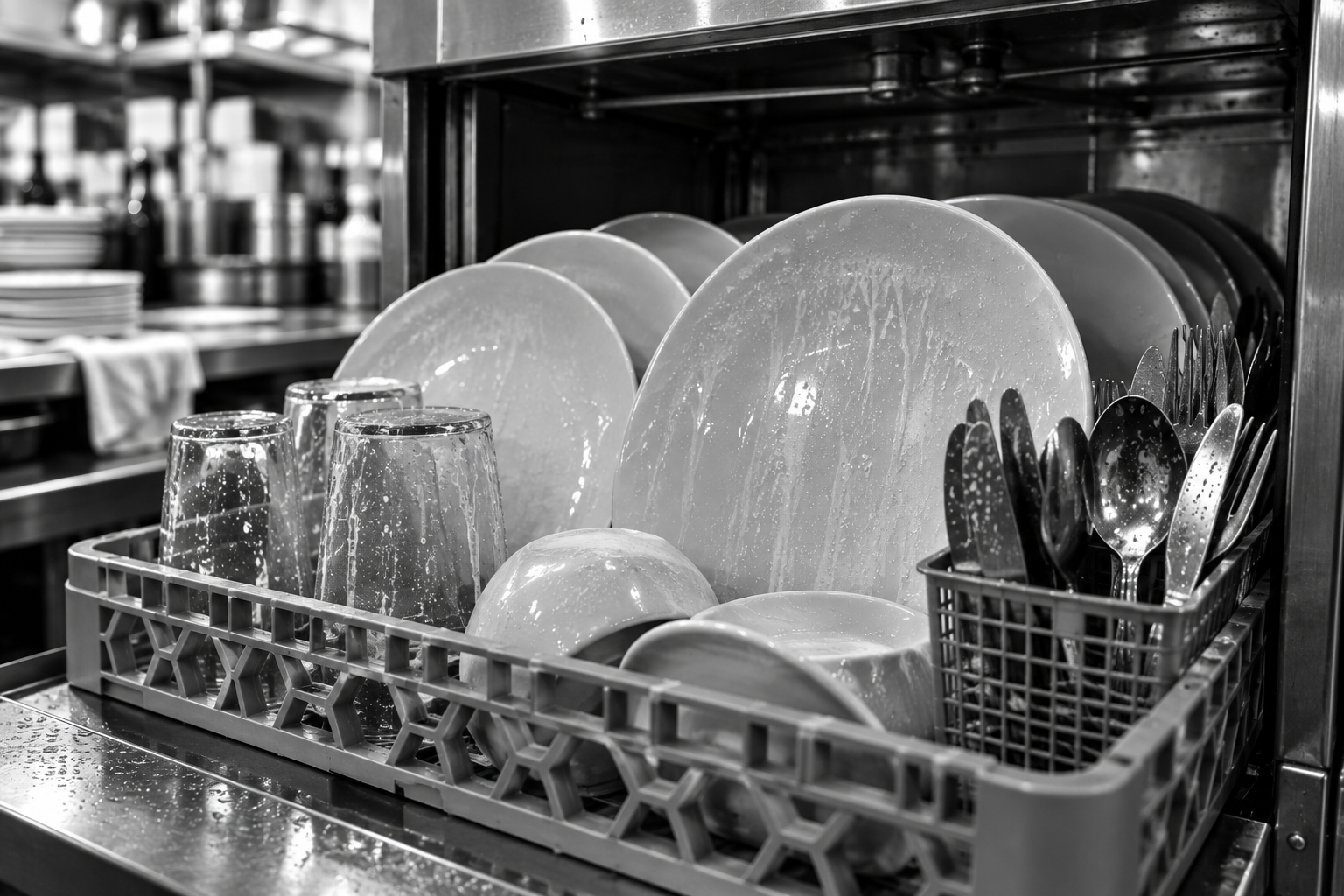
Commercial Dishwasher Not Rinsing Properly?
Poor Rinse Results? Get Your Dishwasher Performing Properly Again.
Your commercial dishwasher may complete the entire wash cycle, but if it isn't rinsing properly, dishes can come out with detergent residue, food particles, streaks, spots or an unacceptable finish.
For a busy restaurant, café, club, hotel, hospital or commercial kitchen, that can mean staff rewashing dishes, hand-polishing glassware and slowing down service.
Worldwide CDM provides professional commercial dishwasher repairs across Sydney, diagnosing rinse-system, water, heating and control faults to identify why your dishwasher isn't rinsing as it should.
Keep Serving Customers With Confidence.
Signs Your Commercial Dishwasher Isn't Rinsing Properly
A rinse problem isn't always immediately obvious.
Your dishwasher may still fill, wash and complete its cycle while the final results gradually become worse.
Common symptoms can include:
Detergent residue remaining on dishes
White marks or film
Spotting or streaking
Food particles remaining after the cycle
Poorly finished glassware
Dishes requiring another cycle
Weak or uneven rinse-water distribution
Some areas of the rack rinsing better than others
Abnormal rinse temperature
An error code relating to water, temperature or rinsing
The symptoms alone don't identify the failed component.
The cause needs to be diagnosed.
Why Is My Commercial Dishwasher Not Rinsing Properly?
Commercial dishwashers rely on several systems working together to produce an effective final rinse.
Depending on the machine, poor rinsing may involve the water supply, rinse arms, spray jets, heating system, booster boiler, chemical dosing or electrical controls.
The exact design varies between commercial dishwasher brands and models.
1. Blocked Rinse Arms or Rinse Jets
Rinse arms distribute rinse water across the dishes.
Small openings within these components can become restricted by food debris, mineral deposits or scale.
If some rinse jets are restricted, water may not be distributed evenly across the rack.
You might notice:
One section of the rack consistently has residue
Water distribution appears uneven
Dishes in certain positions look worse than others
The rinse action appears weaker than normal
Operator-removable rinse arms should be inspected and cleaned according to the manufacturer's instructions.
If the components are clean and the problem continues, further investigation may be required.
2. Insufficient Rinse-Water Flow
The rinse system needs an appropriate supply of water to operate as designed.
If rinse-water flow is inadequate, dishes may not receive the rinse performance expected from the machine.
Depending on the installation and dishwasher, diagnosis may need to consider:
Incoming water supply
Inlet components
Restrictions within the water path
Rinse-system components
Water-control components
Machine-specific valves or controls
A weak rinse doesn't automatically mean the rinse arms are faulty.
The complete water path may need to be checked.
3. Commercial Dishwasher Booster Boiler Problems
Many commercial warewashing systems use a booster or boiler arrangement as part of providing heated rinse water.
If the booster system isn't operating correctly, the dishwasher may not achieve its intended rinse conditions.
Possible faults can involve components such as:
Heating elements
Thermostats
Temperature sensors
Safety devices
Contactors or relays
Electrical controls
Related wiring
A booster problem should be properly diagnosed rather than assuming the heating element has failed.
4. Commercial Dishwasher Not Reaching Rinse Temperature
If the dishwasher isn't achieving the rinse temperature required by its design, the problem may involve the heating or temperature-control system.
Depending on the machine, this can involve:
Heating elements
Temperature sensors
Thermostats
Booster boiler components
Electrical controls
Water supply conditions
If your machine displays wash and rinse temperatures, note what it is showing when the problem occurs.
Don't adjust internal thermostats or temperature controls yourself.
5. Rinse Aid Dosing Problems
Poor rinse results aren't always caused by water flow or temperature.
Rinse aid is used to assist the finishing process and help water drain from the surface of dishes and glassware.
Incorrect rinse-aid dosing can contribute to:
Spotting
Streaking
Poor drying
Unsatisfactory glassware finish
A dosing problem may involve:
An empty chemical container
Incorrect chemical concentration
Chemical tubing
A dosing pump
Incorrect setup
The wrong chemical
Increasing the rinse aid isn't automatically the solution.
The dosing system should be checked and set appropriately for the equipment, chemicals and operating conditions.
6. Detergent Residue Remaining on Dishes
If dishes are coming out with detergent residue, the problem may involve more than the detergent itself.
Possible factors can include:
Incorrect detergent concentration
Inadequate rinsing
Chemical dosing problems
Restricted rinse-water distribution
Water conditions
Incorrect machine operation
If your dishwasher previously produced clean dishes and detergent residue has suddenly started appearing, something in the process may have changed.
7. Scale and Mineral Build-Up
Commercial dishwashers repeatedly heat and circulate water, which means mineral deposits can develop on water-contact components depending on water conditions.
Scale can potentially affect parts of the:
Rinse arms and jets
Heating system
Booster boiler
Water passages
Tank
Sensors
Other water-contact components
However, poor rinsing doesn't automatically mean the dishwasher requires descaling.
Scale should be confirmed before unnecessary work is carried out.
8. Water Inlet Problems
The dishwasher's rinse system ultimately depends on an adequate water supply.
Depending on the particular machine, problems involving the water inlet system can affect rinse performance.
Possible areas for investigation may include:
Incoming water supply
Inlet valve
Inlet filters or strainers
Water-control components
Related electrical controls
The manufacturer's requirements for the particular dishwasher should be considered when assessing the water supply.
9. Electrical or Control Problems
Commercial dishwashers coordinate filling, washing, heating and rinsing through electrical or electronic controls.
A rinse component may be mechanically capable of operating but not being activated correctly.
Depending on the machine, diagnosis may need to consider:
Control boards
Timers
Relays
Contactors
Sensors
Switching components
Wiring
This is why replacing the first component associated with rinsing isn't always the correct repair.
Poor Rinsing or Poor Washing?
These two problems can look very similar.
Poor Washing
If food and grease remain on the dishes, the problem may be more closely related to the wash stage.
Possible areas include the wash pump, wash arms, filters, water level, temperature and detergent.
Poor Rinsing
If dishes appear washed but come out with residue, streaks, spots or poor finishing, the rinse stage may require closer investigation.
A commercial dishwasher can also have more than one problem at the same time.
Correct diagnosis means identifying which part of the warewashing process isn't performing properly.
What Are Your Dishes Coming Out Like?
White Marks or Chalky Residue
Water quality, mineral deposits, chemicals, scale and rinse performance may need to be considered.
Detergent Film
Chemical concentration and rinse performance should be investigated.
Spots or Streaks
Rinse aid, water conditions and rinse performance may be contributing.
Food Still on the Dishes
The problem may be occurring primarily during the wash stage rather than the final rinse.
Cloudy Glassware
Water quality, chemical conditions, rinse performance and the condition of the glass itself can all be relevant.
Only Part of the Rack Looks Bad
Uneven results can provide an important clue that water isn't being distributed correctly.
What Can Kitchen Staff Check Before Calling a Technician?
There are several simple observations your team can make without dismantling the dishwasher.
1. Check the Rinse Aid
Make sure the chemical container isn't empty and the correct product is connected.
2. Inspect Operator-Accessible Rinse Arms
Check accessible rinse arms and jets for obvious debris or deposits.
Only remove components intended for normal operator cleaning.
3. Clean the Filters
Clean operator-accessible filters and strainers according to the machine's instructions.
4. Check the Dishwasher Display
If the machine displays rinse temperature, note the reading.
Also record any error code.
5. Look at the Pattern
Is every dish affected?
Or are dishes in one particular area of the rack consistently worse?
6. Tell Us What Changed
When booking a service, tell us if the problem began after:
Changing chemicals
Running out of rinse aid
Changing water-treatment equipment
A previous dishwasher fault
An error code
A noticeable temperature change
Recent maintenance or repairs
These details can help narrow down the problem.
Don't Keep Adjusting the Dishwasher to Compensate
If dishes suddenly stop rinsing properly, randomly changing chemical or temperature settings can make the original problem harder to identify.
And if there's an underlying equipment fault, adjusting the settings doesn't repair it.
If your dishwasher previously produced good results and something has changed:
Find out why.
Commercial Dishwasher Rinse Problems Sydney
Worldwide CDM provides professional commercial dishwasher fault diagnosis and repairs across Sydney.
Depending on the machine and symptoms, we can investigate faults involving:
Rinse arms and jets
Rinse-water systems
Water inlet systems
Booster boilers
Heating elements
Thermostats
Temperature sensors
Chemical dosing equipment
Electrical controls
Scale-related equipment problems
Wash and rinse performance
The goal isn't simply to make the dishwasher complete a cycle.
It's to help get your equipment producing the results your commercial kitchen needs.
Why Proper Rinsing Matters
Your customer doesn't know whether a mark on their plate was caused by a rinse jet, chemical problem, water condition or equipment fault.
They simply see a dish that doesn't look clean.
Your staff shouldn't have to spend a busy service:
Rewashing dishes
Wiping plates
Polishing glassware
Running additional cycles
or checking every item before it reaches the customer.
Reliable warewashing helps your team focus on service instead of working around equipment problems.
Commercial Dishwasher Brands We Repair
Worldwide CDM repairs and services many leading commercial dishwasher brands, including:
Don't see your dishwasher brand listed?
Our experienced technicians repair many other commercial dishwasher makes and models used throughout Sydney.
How Worldwide CDM Diagnoses Commercial Dishwasher Rinse Problems
You Keep Serving Customers. We'll Help Get Your Equipment Back on Track.
1. Tell Us What's Happening
Provide the dishwasher's brand, model, symptoms and any error code.
Tell us exactly what you're seeing on the dishes.
2. We Diagnose the Problem
Our technician investigates the systems relevant to the symptoms and particular machine.
Depending on the fault, this may involve the:
Rinse system
Rinse arms and jets
Water supply
Heating system
Booster boiler
Temperature controls
Chemical dosing system
Electrical controls
and other machine-specific components.
3. We Explain What We've Found
We'll explain what's causing the problem and what is required to correct it.
4. We Repair What's Required
Where an equipment repair is necessary, we'll repair or replace the relevant components using appropriate parts, including genuine manufacturer spare parts where available.
5. We Test the Dishwasher
Following repair, the relevant functions are tested to check that the reported fault has been addressed.
Diagnose first. Repair what's required. Avoid unnecessary parts.
Why Choose Worldwide CDM?
Your Dishwasher Should Support Your Service — Not Slow It Down.
When your commercial dishwasher stops rinsing properly, you shouldn't have to guess which component is causing it.
Worldwide CDM provides:
✔ 30+ years supporting Sydney's hospitality industry
✔ Experienced commercial catering equipment technicians
✔ Commercial dishwasher fault diagnosis and repairs
✔ Repairs for leading commercial dishwasher brands
✔ Genuine spare parts
✔ Preventative maintenance programs
✔ Reliable workmanship
✔ Straightforward, honest advice
✔ Service throughout Sydney
Keep Serving Customers With Confidence.
Frequently Asked Questions
Why is my commercial dishwasher not rinsing properly?
Possible causes include restricted rinse arms or jets, insufficient water flow, water inlet problems, incorrect rinse temperature, booster boiler faults, chemical dosing problems, scale or electrical/control faults. The exact cause depends on the machine and symptoms.
Why is detergent being left on dishes after the dishwasher?
Detergent residue can be associated with incorrect chemical concentration, poor rinse performance, restricted water distribution or other operating conditions. The rinse and chemical systems may need to be checked.
Why is my commercial dishwasher leaving white residue?
White residue can be associated with minerals, water quality, scale, chemical concentration or poor rinsing. The appearance of the residue and whether it can be removed can help narrow down the cause.
Can blocked rinse arms cause poor rinsing?
Yes. Restricted rinse jets can interfere with water distribution and produce uneven results across the rack.
Can a booster boiler problem affect rinsing?
Yes. On machines that use a booster system for the final rinse, a heating or control problem can affect the rinse conditions the machine is designed to achieve.
Why are only some dishes not rinsing properly?
If the problem repeatedly affects one area of the rack, rinse-water distribution, spray components and loading may need to be investigated.
Should I increase the rinse aid?
Not automatically. Too little or too much chemical can affect results. If the dishwasher previously performed correctly, determine what's causing the change before repeatedly adjusting the dosing.
Do you repair commercial dishwashers that aren't rinsing properly in Sydney?
Yes. Worldwide CDM diagnoses and repairs commercial dishwasher rinse, heating, water, chemical dosing and related equipment faults across Sydney on the commercial dishwasher brands we service.
Commercial Dishwasher Not Rinsing Properly?
Get Back to Clean, Presentable Dishes.
Your team has customers to serve — not time to keep rewashing and polishing dishes because your dishwasher isn't performing properly.
Tell Worldwide CDM what's happening.
We'll diagnose the equipment problem, explain what we've found and recommend the appropriate repair.
Keep Serving Customers With Confidence.
Related Commercial Catering Equipment Repairs
Worldwide CDM also provides professional repairs for: