
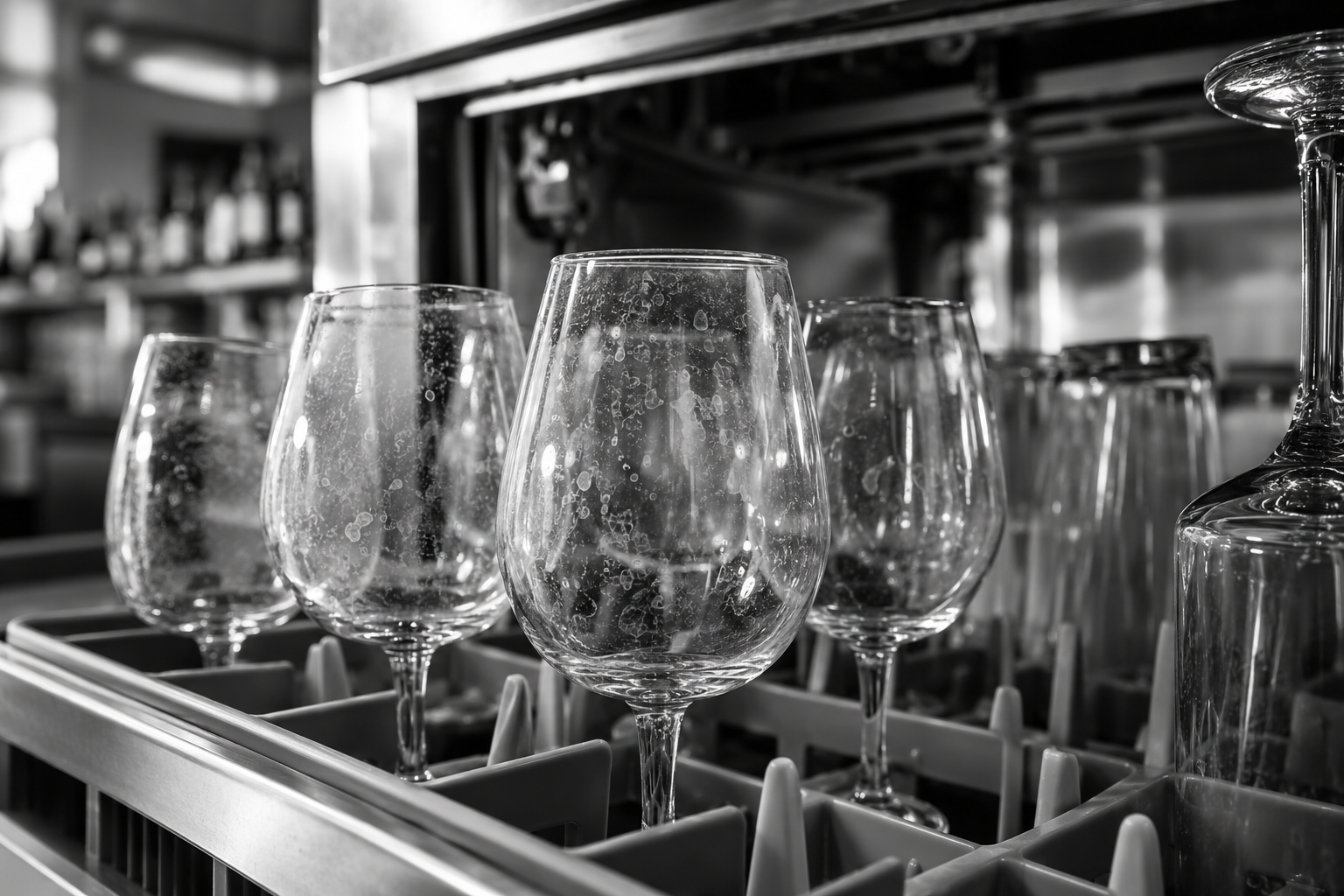
Commercial Glasswasher Leaving White Marks On Glasses
Commercial Glasswasher Leaving White Marks on Glasses?
White Spots, Streaks or Residue on Clean Glassware?
Your glasswasher finishes its cycle, but the glasses coming out don’t look ready to serve.
Instead, you notice white spots, chalky marks, streaks, rings or a fine residue across the surface.
For a busy cocktail bar, restaurant, pub, club or hotel, that’s more than a cosmetic problem. Staff may need to polish every glass by hand, glass turnaround slows down and glassware that should look clean can reach the customer looking marked or dull.
The glasswasher may still be running normally, but something within the washing process isn’t producing the result you expect.
Worldwide CDM provides commercial glasswasher repairs and servicing across Sydney, helping hospitality businesses identify whether white marks are being caused by water hardness, scale, chemical dosing, rinsing, temperature, water treatment or another problem.
We Find the Fault Before We Sell the Fix.
When Equipment Stops, Your Kitchen Doesn't Have To.
Why Is My Commercial Glasswasher Leaving White Marks on Glasses?
White marks on glassware can have several possible causes.
Depending on the appearance of the marks and when they occur, possible causes can include:
Hard water
Mineral deposits
Scale build-up
Incorrect rinse-aid dosing
Incorrect detergent dosing
Poor rinse performance
Blocked rinse jets
Water-softener problems
Water-treatment problems
Wash or rinse temperature problems
Chemical residue
Water drying on the glass surface
Permanent glass damage
The important point is that white marks don’t automatically mean the glasswasher has a mechanical fault.
Before changing chemicals or replacing components, the cause needs to be identified.
Treat the Cause, Not Just the Mark.
What Are the White Marks on My Glasses?
One of the first things to establish is whether the white marks are deposits sitting on the glass or permanent changes to the glass surface.
Mineral deposits and some residues may remain on the surface after washing and drying.
Permanent etching is different because the surface of the glass itself has been altered.
The two can look similar, but the solution is completely different.
If the marks are caused by deposits, the glasswashing process, water conditions or chemical balance may require attention.
If the glass has been permanently etched, replacing glasswasher parts won’t restore the damaged surface.
Good Diagnosis Means Knowing When the Machine Isn’t the Problem.
Hard Water and White Marks on Glasses
Hard water contains dissolved minerals, particularly calcium and magnesium.
When water droplets remain on glassware and evaporate, minerals can be left behind.
These deposits may appear as:
White spots
Chalky marks
Droplet patterns
Cloudiness
Streaks
Fine mineral film
If the marks appear where droplets have dried, water hardness should be considered.
You may also notice increasing white or chalky deposits inside the glasswasher itself.
That combination can indicate a broader water-quality or water-treatment issue rather than simply dirty glassware.
Commercial Glasswasher Scale Build-Up
Scale is the hard mineral deposit that can develop when hardness minerals accumulate within equipment.
In a commercial glasswasher, scale may form around:
Heating surfaces
Booster components
Wash arms
Rinse arms
Rinse jets
Tank surfaces
Water pathways
Valves and other water-contact components
Scale inside the machine can become more than a maintenance issue.
If rinse jets or water pathways become restricted, the glasswasher may not distribute water as intended.
That can contribute to inconsistent rinsing and poor glass presentation.
Removing visible scale may address the deposit, but if scale quickly returns, the reason it is forming should also be investigated.
Descaling the Machine Without Addressing the Cause Can Mean the Same Problem Comes Back.
Commercial Glasswasher Water Softener Problems
Where a water softener is installed, its job is to reduce hardness minerals reaching the glasswasher.
Depending on the system, correct operation may rely on salt, ion-exchange resin, regeneration, water flow, valves, controls and correct settings.
A water softener can appear to be operating while not providing the expected level of softening.
If white marks on glasses are occurring together with rapid scale accumulation inside the machine, the water-softening system may need attention.
Continually adjusting the glasswasher won’t solve a water-treatment problem upstream.
Commercial Glasswasher Rinse Aid Problems
Rinse aid helps water drain from the glass surface during the final stage of the glasswashing process.
Correct dosing can help reduce water remaining on glassware as droplets.
If rinse-aid delivery is incorrect, staff may notice:
Water spots
Streaking
Poor drying
Uneven appearance
Film or residue
Excessive droplets remaining on glasses
However, simply adding more rinse aid isn’t necessarily the solution.
Both insufficient and excessive dosing can affect results.
The correct setting depends on the chemical product, glasswasher, water conditions and operating requirements.
Commercial Glasswasher Detergent Dosing Problems
Incorrect detergent dosing can also affect the finished glass.
Too little detergent may reduce wash performance.
Excessive detergent or detergent that isn’t being adequately rinsed away may contribute to residue or film.
Possible chemical-dosing problems can involve:
Empty chemical containers
Incorrect settings
Blocked dosing lines
Damaged tubing
Dosing pump faults
Poor priming
Chemical changes
Control problems
If the white marks appeared after changing detergent or adjusting the dosing system, that information can help identify the cause.
White Marks After Changing Glasswasher Chemicals
A change in detergent or rinse aid can change the way the glasswasher performs.
Different chemical products can have different concentrations and recommended dosing requirements.
Settings that worked with the previous product may not necessarily suit the replacement.
If the glasswasher previously produced clear glassware and white marks appeared shortly after a chemical change, investigate the change before assuming the machine has developed an unrelated mechanical fault.
More Chemical Doesn’t Automatically Mean Cleaner Glasses.
Commercial Glasswasher Not Rinsing Properly
A glass can be washed effectively but still leave the machine with visible residue if the final rinse isn’t performing correctly.
Poor rinse performance may involve:
Blocked rinse jets
Restricted rinse arms
Scale accumulation
Water-flow problems
Water-pressure problems
Rinse valve faults
Booster problems
Temperature problems
Water-supply conditions
Other machine-specific faults
If residue consistently appears on glasses positioned in one area of the rack, rinse coverage may be worth investigating.
Blocked Commercial Glasswasher Rinse Jets
Commercial glasswasher rinse jets contain relatively small openings designed to distribute rinse water across the rack.
Mineral scale or debris can restrict these openings.
When the spray pattern changes, some glasses may receive less effective rinsing than others.
Staff may notice that one side of the rack produces worse results, certain glasses repeatedly have marks or residue appears in similar locations.
Operator-removable rinse components should be cleaned according to manufacturer instructions.
If blockages repeatedly return, the underlying cause should also be considered.
White Marks Appearing Only After the Glass Dries
This is an important clue.
A glass may look clear immediately after leaving the machine but develop visible white spots as it dries.
When water evaporates, dissolved minerals or other residues can remain behind.
If the marks correspond with dried droplets, possible factors include:
Water hardness
Rinse-aid performance
Rinse quality
Mineral content
Drying behaviour
Water treatment
Observing when the marks become visible can help distinguish between different causes.
White Marks or Cloudy Glasses?
White marks and cloudy glassware can occur for related reasons, but they don’t always present in the same way.
White marks may appear as individual spots, droplet outlines, streaks, rings, chalky patches or localised residue.
Cloudiness is more likely to appear as a broader haze or dull appearance across the glass.
Both can involve water hardness, chemicals, scale or rinse performance, but identifying the exact appearance can help narrow down the problem.
Why Are Wine Glasses Getting White Marks?
White marks can be particularly noticeable on wine glasses because customers expect the glass to be clear and polished.
Possible causes can include mineral deposits, hard water, rinse-aid problems, chemical residue, poor rinsing, scale, water-treatment problems or glass surface damage.
For a restaurant, wine bar or hotel, having staff repeatedly polish every wine glass after washing is inefficient.
If the same marks keep returning after every cycle, the underlying cause should be addressed.
Why Are Cocktail Glasses Coming Out Spotted?
Cocktail glassware can make spotting particularly visible under bar lighting.
A premium drink served in a glass covered with white spots can undermine the presentation before the customer even tastes it.
If cocktail glasses are repeatedly coming out spotted, consider whether the problem affects every rack, only certain glass types, certain positions in the rack, busy service periods or only after the glass dries.
Patterns can provide useful information when diagnosing the problem.
Why Are Beer Glasses Leaving the Glasswasher With White Marks?
Beer glasses can also develop visible spots, streaks or residue after washing.
The cause may involve water quality, rinsing, chemical dosing, scale or glass condition.
If the same machine is producing different results across different glass types, the age, surface condition and previous use of the glassware should also be considered.
Not every presentation problem originates inside the glasswasher.
Could the White Marks Be Permanent Glass Etching?
Yes.
Some marks that initially look like mineral deposits may actually be permanent damage to the glass surface.
Glass etching can create a dull, frosted or marked appearance that doesn’t simply rinse or wipe away.
If the glass itself has been permanently damaged, changing rinse aid, descaling the machine or replacing components won’t restore the original surface.
Sometimes Honest Advice Means Telling You the Glasswasher Isn’t What Needs Fixing.
Why Are Only Some Glasses Getting White Marks?
If only certain glasses are affected, look for patterns.
Consider:
Glass type
Glass age
Rack position
Surface condition
Loading
Previous chemical exposure
Existing damage
Different beverage residues
If every glass in the machine is affected, a system-wide issue becomes more relevant.
If only one particular type of glass is affected, the glassware itself may also need consideration.
Why Are Staff Having to Hand Polish Every Glass?
Polishing glassware is normal in some hospitality settings.
Having to remove visible white marks from every rack because the glasswasher isn’t producing acceptable results is different.
Repeated manual polishing can mean more staff time, slower glass turnaround, additional handling and greater pressure during peak service.
If the marks return after every cycle, correcting the cause is more effective than accepting hand polishing as the solution.
Can Glasswasher Temperature Cause White Marks?
Temperature forms part of the overall commercial glasswashing process, but it shouldn’t automatically be blamed for white marks.
Where a genuine temperature problem exists, possible causes can include heating elements, thermostats, temperature sensors, booster systems, contactors, relays, controls or scale accumulation.
Temperature should be considered alongside water quality, chemicals and rinse performance rather than diagnosed from the appearance of the glass alone.
What Can Staff Check Before Booking a Service?
Check the Chemical Levels
Confirm detergent and rinse aid are available and being supplied normally.
Look at the Pattern of the Marks
Are they spots, streaks, rings, cloudiness or a general film?
Check When the Marks Appear
Are they visible immediately or only once the glass dries?
Look for Scale Inside the Glasswasher
White or chalky deposits inside the machine may indicate mineral accumulation.
Check Operator-Removable Rinse Components
Clean rinse arms and jets according to manufacturer instructions.
Consider Recent Changes
Has the venue changed detergent, rinse aid, glassware or water-treatment settings?
Check Whether Every Glass Is Affected
The pattern can help determine whether the problem is system-wide.
Find the Glasswasher Brand and Model
Providing the equipment details helps identify the particular wash, rinse and dosing systems being used.
Don’t Keep Increasing Chemicals Until the Marks Disappear
When glasses aren’t coming out correctly, randomly adjusting detergent and rinse-aid settings can create additional problems.
Commercial glasswashing relies on the interaction between water quality, wash action, temperature, detergent, rinse aid, rinse performance, water treatment and cycle conditions.
The correct solution depends on which part of that process isn’t working as intended.
Fix the Cause Instead of Chasing the Symptom.
How Worldwide CDM Diagnoses White Marks on Glassware
1. Tell Us What You’re Seeing
Tell us whether the glassware has white spots, chalky residue, streaks, rings, cloudiness or another visible mark.
Let us know whether the marks appear immediately or after the glass dries.
2. We Look at the Whole Glasswashing Process
Depending on the symptoms, relevant areas may include the rinse system, chemical dosing, water conditions, water treatment, scale, heating and other glasswasher components.
3. We Identify What’s Actually Causing the Problem
The objective is to establish whether the problem originates from the glasswasher, water, chemicals, glassware or a combination of factors.
4. We Explain What We’ve Found
If a component requires repair, we’ll explain why.
If the problem is related to water treatment, chemicals or permanently damaged glassware, we’ll explain that too.
5. We Recommend What the Equipment Actually Needs
No trial-and-error parts replacement.
No assuming the most expensive component must be responsible.
The goal is to identify the problem and recommend the appropriate solution.
We Find the Fault Before We Sell the Fix.
Commercial Glasswasher Repairs Sydney
Worldwide CDM provides commercial glasswasher repairs and servicing across Sydney for restaurants, cocktail bars, wine bars, pubs, clubs, hotels, cafés, function venues, catering businesses and commercial kitchens.
When glassware isn’t coming out clean and presentation-ready, we’ll help determine what’s causing the problem.
Commercial Glasswasher Brands We Service
Worldwide CDM services and repairs leading commercial glasswasher brands including:
Preventing White Marks on Commercial Glassware
Not every glass presentation problem can be prevented through servicing alone, but good operating practices can reduce avoidable issues.
Depending on the glasswasher and manufacturer requirements, this can include keeping filters and rinse components clean, maintaining correct chemical dosing, maintaining water-softening equipment where fitted, addressing scale accumulation and investigating changes in glasswashing performance early.
If clear glassware suddenly begins leaving the machine with visible marks, don’t simply make the new result part of the venue’s routine.
A change usually has a reason.
Routine Commercial Glasswasher Servicing
A commercial glasswasher in a busy hospitality venue may process rack after rack of glassware throughout a single service.
Routine servicing provides an opportunity to assess relevant components and identify developing issues before some faults become more disruptive.
Depending on the glasswasher, servicing may include assessment of wash and rinse systems, chemical dosing, heating, pumps, water systems, scale accumulation, electrical components and the overall condition of the machine.
Servicing requirements should reflect the particular equipment, manufacturer recommendations, usage and operating environment.
Why Choose Worldwide CDM?
30+ Years Helping Sydney Hospitality Businesses Keep Moving
Founded by Robert and now operated alongside his son Joel, Worldwide CDM is a family-run commercial catering equipment business built on technical experience, straightforward advice and long-term customer relationships.
For more than 30 years, we’ve helped Sydney hospitality businesses keep essential commercial kitchen and warewashing equipment operating.
Our approach is simple: understand the symptom, diagnose the cause, explain what we’ve found and recommend what actually needs attention.
If the glasswasher is responsible for the white marks, we’ll work to identify the fault.
If the problem is water quality, chemical dosing, water treatment or the glassware itself, we’ll tell you that too.
We Find the Fault Before We Sell the Fix.
Keep Serving Customers With Confidence.
Frequently Asked Questions
Why is my commercial glasswasher leaving white marks on glasses?
Possible causes include hard water, mineral deposits, scale, incorrect rinse-aid or detergent dosing, poor rinse performance, water-softener problems or permanent glass damage.
Does hard water cause white spots on glasses?
Yes. Dissolved minerals in hard water can remain on the glass after water evaporates, creating visible spots or deposits.
Why do the white marks only appear after the glasses dry?
Minerals or other residues dissolved in water may become visible after the water evaporates from the glass surface.
Can rinse aid cause white marks on glasses?
Incorrect rinse-aid dosing can contribute to spotting, streaking and poor glass appearance. The correct setting depends on the chemical product, glasswasher and water conditions.
Can too much detergent leave residue on glasses?
Incorrect detergent concentration can contribute to poor glasswashing results, particularly where residue isn’t being adequately rinsed from the glassware.
Can a water softener cause white marks on glasses?
A poorly performing water softener may allow hardness minerals to reach the glasswasher, increasing the likelihood of mineral deposits and scale.
Can scale inside a glasswasher affect the rinse?
Scale can restrict rinse jets and water pathways, potentially affecting water distribution and rinse performance.
Why are only some of my glasses getting white marks?
Glass type, age, rack position, loading, surface condition and existing damage can all influence results. The pattern can help identify whether the problem is machine-wide.
Are white marks always removable?
No. Some cloudy or white-looking marks may be permanent glass etching rather than removable residue.
Should I increase the rinse aid if my glasses have white spots?
Not automatically. White spots can have several causes. Changing chemical dosing without identifying the cause may create additional problems.
Why does my commercial glasswasher keep developing scale?
Recurring scale may indicate hard incoming water, water-softener problems, incorrect regeneration or another water-treatment issue.
Do you repair commercial glasswashers leaving white marks on glasses in Sydney?
Yes. Worldwide CDM diagnoses commercial glasswasher performance problems across Sydney, including faults involving rinsing, dosing, heating, water systems and scale.
Commercial Glasswasher Leaving White Marks on Glasses?
Your Glassware Should Be Ready to Serve, Not Ready to Rewash.
When the bar is busy, your team needs glassware coming out clean, clear and ready for the next customer.
They shouldn’t have to inspect and repolish every rack because white spots and residue keep returning.
Worldwide CDM combines more than 30 years of commercial catering equipment experience with practical fault diagnosis and straightforward advice.
We’ll help determine whether the problem is coming from the glasswasher, water conditions, chemical dosing, water treatment or the glassware itself.
We Find the Fault Before We Sell the Fix.
When Equipment Stops, Your Kitchen Doesn't Have To.
Keep Serving Customers With Confidence.
Related Commercial Catering Equipment Repairs
Worldwide CDM also provides professional repairs for: