
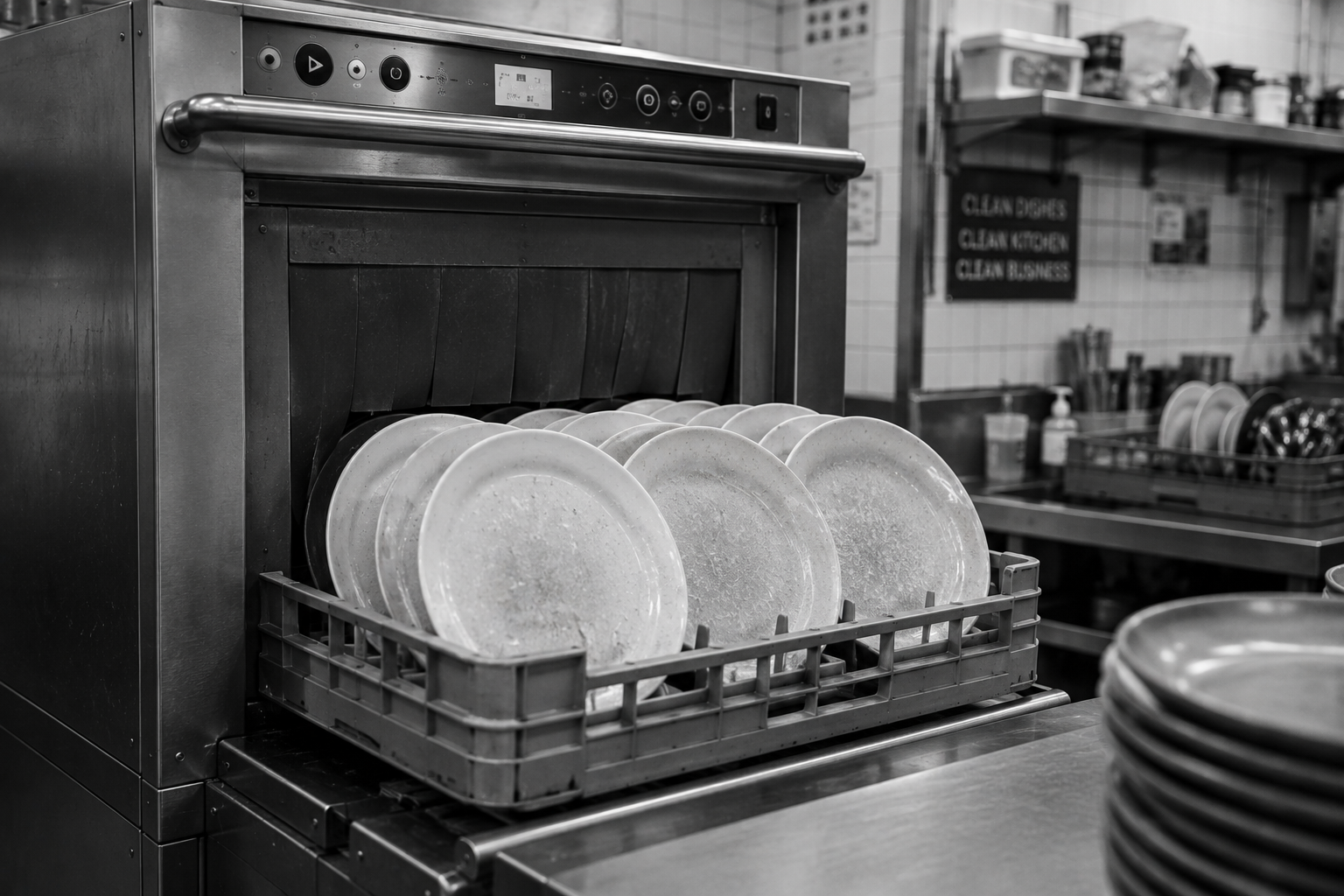
Commercial Dishwasher Water Softener Problems
White Marks, Scale or Poor Wash Results? Your Dishwasher May Have a Water Softener Problem.
Your team needs clean plates and sparkling glassware ready for the next customer.
Instead, you're starting to notice white marks on dishes, cloudy glasses, mineral deposits around the machine or scale building up where it wasn't before.
You clean the dishwasher.
You change the detergent.
You polish the glasses.
But the problem keeps coming back.
Where a commercial dishwasher uses a water softener, the issue may be with the softener itself, its regeneration process, salt supply, settings or another part of the water-treatment system.
Worldwide CDM diagnoses commercial dishwasher water softener problems across Sydney, helping identify whether water treatment, the dishwasher or another operating condition is responsible.
Keep Serving Customers With Confidence.
What Does a Commercial Dishwasher Water Softener Do?
Hard water contains dissolved minerals, particularly calcium and magnesium.
When hard water is heated and evaporates, these minerals can contribute to scale and deposits on equipment and ware.
A correctly operating ion-exchange water softener reduces hardness by exchanging calcium and magnesium ions for sodium ions.
Depending on the dishwasher and installation, the softener may be:
Built into the dishwasher
Installed externally
Manually regenerated
or automatically regenerated.
Not every commercial dishwasher has a water softener, and not every water-quality problem is caused by one.
That's why diagnosis matters.
Signs of a Commercial Dishwasher Water Softener Problem
Possible signs include:
White marks appearing on dishes
Cloudy or marked glassware
Scale developing inside the dishwasher
Mineral deposits around heating components
Scale around wash or rinse jets
Increasing mineral build-up
Poorer rinse results
Salt being consumed unusually quickly
Salt level not changing over time
Regeneration problems
Water remaining hard after treatment
Changes in results despite normal chemical use
These symptoms can point toward a water-treatment issue, but several other dishwasher problems can produce similar results.
Don't assume it's the softener simply because you can see white marks.
Commercial Dishwasher Water Softener Not Working
A water softener needs to operate correctly to continue treating incoming water.
Depending on the particular system, problems can involve:
Incorrect regeneration
Insufficient salt
Salt-related problems
Incorrect settings
Valves
Restricted water flow
Control components
Resin condition
Installation issues
or other system-specific faults.
The first step is establishing whether the water entering the dishwasher is actually being softened as intended.
Why Is My Commercial Dishwasher Leaving White Marks?
White marks can be frustrating because there isn't one universal cause.
Depending on the appearance and operating conditions, possible causes can include:
Hard-water mineral deposits
Water softener problems
Incorrect detergent concentration
Rinse-aid issues
Chemical residue
Incorrect rinse conditions
Scale within the dishwasher
Water-quality changes
If the marks have appeared suddenly after previously good results, ask what changed.
Good diagnosis starts with the symptom — not with guessing which part to replace.
Cloudy Glasses and Water Softener Problems
Cloudy glassware is another symptom often blamed immediately on hard water.
Hardness can contribute to mineral deposits, but cloudy glasses can also result from:
Chemical dosing
Rinse-aid problems
Water temperature
Wash conditions
Mineral deposits
Glass condition
and other factors.
Some deposits may be removable while permanent glass damage may not be.
Before changing chemicals or replacing equipment, determine what's actually causing the cloudy appearance.
Commercial Dishwasher Scale Build-Up
Scale can form where mineral-containing water is repeatedly heated.
Depending on the machine and water conditions, deposits may affect areas such as:
Heating elements
Booster systems
Wash tanks
Rinse jets
Wash arms
Pipework
Temperature-sensing components
Scale can reduce heat transfer and restrict water pathways when accumulation becomes significant.
This is why water treatment can matter beyond the appearance of dishes and glasses.
It's also about protecting the systems your dishwasher depends on.
Water Softener Salt Problems
Many ion-exchange softeners require appropriate regenerant salt to restore the resin's ability to soften water.
If the system requires salt and doesn't have enough available for correct regeneration, softening performance can deteriorate.
Kitchen staff should follow the manufacturer's requirements for the particular softener.
Depending on the system, problems can involve:
Salt level too low
Incorrect salt
Salt not dissolving or feeding correctly
Regeneration not occurring
Salt-related blockages or bridging
Other brine-system problems
Simply filling the salt reservoir doesn't prove the softener is working correctly.
Water Softener Salt Level Never Changes
If the salt level appears unchanged for an unusually long period despite regular dishwasher operation, it may be worth investigating.
Depending on the system, this can indicate that regeneration isn't occurring normally or that there is another problem with the softener.
However, salt consumption varies considerably according to:
Softener design
Regeneration settings
Incoming water hardness
Water usage
Equipment capacity
Don't judge a system solely by how quickly it uses salt.
Look at the entire operating picture.
Water Softener Using Too Much Salt
The opposite problem can also occur.
Unexpectedly high salt consumption can warrant investigation.
Possible considerations may include:
Regeneration frequency
System settings
Water usage
Water hardness
Control problems
Brine-system operation
Leaks or abnormal water consumption
The appropriate salt consumption depends on the equipment and operating conditions.
Commercial Dishwasher Water Softener Regeneration Problems
Ion-exchange softeners have a finite capacity.
Once enough hardness minerals have been captured, the resin needs to be regenerated.
Depending on the softener, regeneration may be:
Automatic
Programmed
Volume controlled
or require manual operator action.
If regeneration doesn't occur correctly or frequently enough for the site's water usage and hardness, hard water can begin reaching the dishwasher.
That can lead to the return of mineral deposits and scale.
Manual Water Softener Regeneration
Some commercial dishwasher installations use manually regenerated softeners.
These systems depend on staff following the correct regeneration procedure at appropriate intervals.
If regeneration is:
Forgotten
Performed incorrectly
Performed too infrequently
or not matched to water consumption
softening performance may deteriorate.
Staff training therefore forms an important part of maintaining some water-softener systems.
Automatic Water Softener Problems
Automatic systems reduce the amount of manual intervention required, but they can still develop faults.
Depending on the system, potential areas requiring investigation may include:
Control settings
Timers
Meters
Valves
Regeneration cycles
Salt/brine system
Water flow
or other equipment-specific components.
Automatic doesn't mean maintenance-free.
Water Softener Resin Problems
Ion-exchange resin is the material responsible for removing hardness ions from the water.
Its performance can be affected over time by factors associated with water chemistry, contamination, regeneration and equipment condition.
A softener that contains salt and appears to regenerate may therefore still require investigation if the treated water isn't achieving the expected hardness.
The condition of the entire system should be considered before assuming any individual component requires replacement.
Hard Water Can Affect Dishwasher Heating Systems
Scale doesn't only affect appearance.
Mineral deposits on heating surfaces can act as an insulating layer.
As scale accumulates, heat transfer can become less efficient.
Depending on the dishwasher, this may contribute to problems involving:
Heating performance
Heating elements
Booster boilers
Temperature recovery
Energy use
Equipment reliability
If your dishwasher is both developing scale and taking longer to heat, tell us.
The two symptoms may be related.
Scale Can Restrict Wash and Rinse Components
Mineral deposits can also accumulate in areas where water needs to flow through relatively small openings.
Depending on the machine, this may affect:
Rinse jets
Wash jets
Rinse arms
Wash arms
Water pathways
Restricted water distribution can contribute to inconsistent washing or rinsing.
Cleaning the visible jet may address the immediate restriction, but recurring scale means the underlying water conditions should also be considered.
Hard Water or Chemical Problem?
This distinction is important.
When glasses or dishes start looking poor, the first reaction is often to change the detergent or rinse aid.
But increasing chemicals won't necessarily solve a water-hardness problem.
Likewise, installing or repairing a softener won't correct a problem caused by incorrect chemical dosing.
Possible factors include:
Water hardness
Water softener operation
Detergent concentration
Rinse-aid concentration
Water temperature
Rinse performance
Wash performance
Loading practices
Treat the cause, not just the appearance of the dishes.
Water Softener Problem or Dishwasher Problem?
Sometimes the softener is operating correctly and the problem is actually inside the dishwasher.
For example:
White Marks on Dishes
Could involve water hardness, chemicals, rinsing or other wash conditions.
Cloudy Glasses
Could involve deposits, chemical conditions, rinse performance or permanent glass damage.
Dishwasher Scaling Up
Water hardness should be considered, but the water-treatment system and operating conditions need to be assessed.
Poor Rinse Results
Could involve rinse arms, jets, pressure, temperature, booster operation, chemicals or water quality.
Dishwasher Taking Too Long to Heat
Scale may contribute, but heating elements, thermostats, sensors, electrical components and other heating faults can produce similar symptoms.
One symptom can have several causes. That's why the whole system matters.
Water Hardness Testing
One of the most useful steps when investigating a suspected softener problem is determining the actual hardness of the water.
Where appropriate, testing can help establish whether:
Incoming water is hard
Treated water is being softened
Hardness is breaking through after treatment
Softener performance is consistent
This provides more useful information than assuming the water is hard based solely on visible deposits.
Why Has Scale Suddenly Started Appearing?
If a dishwasher has operated for a long period without significant scale and deposits suddenly begin appearing, something may have changed.
Possible considerations include:
Softener regeneration
Salt supply
Softener settings
Water usage
Changes to water treatment
Chemical dosing
Machine operation
Recent maintenance or installation changes
Tell the technician when you first noticed the change.
That timeline can be useful.
Should We Just Descale the Dishwasher?
Descaling can remove appropriate mineral accumulation where it is required and compatible with the equipment.
But descaling alone doesn't correct the reason scale formed.
If hard water continues reaching the dishwasher, the deposits can return.
That's why the better question is:
"Why is this dishwasher scaling up?"
rather than simply:
"Can you remove the scale?"
The goal should be to address both the existing condition and, where possible, the underlying cause.
Don't Descale a Commercial Dishwasher Unnecessarily
Not every dishwasher needs descaling at every service.
Descaling should be performed where appropriate for the equipment, its condition and manufacturer requirements.
Using unsuitable chemicals or incorrect procedures can damage components.
If there is little or no scale accumulation, performing unnecessary descaling simply adds cost without addressing a real problem.
Inspect first. Recommend what's actually required.
What Can Kitchen Staff Check?
1. Check the Salt Level
If your softener requires salt, check that the correct product is available at the appropriate level according to its instructions.
2. Check the Regeneration Procedure
If the softener requires manual regeneration, confirm that it is being performed correctly and at the appropriate interval.
3. Look for Scale
Note where deposits are appearing.
For example:
Inside the tank
Around heating components
On rinse jets
On wash arms
On dishes
or on glassware.
4. Check Whether the Problem Is New
Tell us whether the machine has always produced these results or whether something recently changed.
5. Check Chemical Levels
Make sure detergent and rinse-aid containers aren't empty.
Don't compensate for suspected hard water by simply increasing chemical dosing.
6. Photograph the Results
Photographs of white marks, cloudy glasses or visible scale can be useful.
7. Provide the Brand and Model
Tell us the dishwasher brand and model and, where possible, details of the water-softening equipment.
How Worldwide CDM Diagnoses Commercial Dishwasher Water Softener Problems
You Need Clean Ware and Reliable Equipment. We'll Work Out What's Getting in the Way.
1. Tell Us What You're Seeing
Provide the dishwasher brand, model and symptoms.
Tell us whether you're experiencing:
Scale
White marks
Cloudy glassware
Poor rinsing
Changes in salt consumption
or another water-related problem.
2. We Assess the Relevant Systems
Depending on the equipment and symptoms, investigation may consider:
Water hardness
Softener operation
Regeneration
Salt/brine system
Softener settings
Water flow
Scale accumulation
Wash and rinse systems
Heating systems
Chemical dosing
and other relevant components.
3. We Identify the Cause
The objective is to establish whether the problem is coming from the water softener, the dishwasher, chemical dosing, operating conditions or a combination of factors.
4. We Explain What We've Found
We'll explain the problem and the appropriate action rather than automatically recommending unnecessary components or maintenance.
5. We Repair or Service What's Required
Where repairs or maintenance are required, the relevant system can be addressed and operation checked as appropriate.
Diagnose first. Service what's required. Avoid unnecessary repairs.
Commercial Dishwasher Water Softener Repairs Sydney
Worldwide CDM provides commercial dishwasher fault diagnosis and servicing throughout Sydney.
We can investigate problems involving:
Commercial dishwasher water softeners
Hard-water problems
Water-softener regeneration
Salt-related issues
Scale build-up
White marks on dishes
Cloudy glassware
Rinse-performance problems
Water-quality-related dishwasher issues
Scale affecting heating systems
Scale affecting wash and rinse systems
Related commercial dishwasher faults
The visible scale is only part of the problem.
Understanding why it's there is what helps prevent it coming straight back.
Protecting Your Commercial Dishwasher From Scale
Water treatment can be an important part of protecting commercial dishwashing equipment in appropriate water conditions.
But it works best as part of a broader approach that includes:
Correct equipment setup
Appropriate water treatment
Correct regeneration
Correct chemical dosing
Routine operator cleaning
Routine servicing
Prompt investigation of performance changes
A water softener isn't a substitute for dishwasher maintenance.
And dishwasher maintenance isn't a substitute for correctly operating the softener.
The two systems need to work together.
Commercial Dishwasher Brands We Repair
Worldwide CDM repairs and services many leading commercial dishwasher brands, including:
Don't see your dishwasher brand listed?
Our experienced technicians repair many other commercial dishwasher makes and models used throughout Sydney.
Why Choose Worldwide CDM?
Your Customers Should Notice the Meal — Not Marks on the Plate or Glass.
When white marks, cloudy glasses or scale start appearing, you don't need someone to simply pour descaler into the dishwasher and leave.
You need to understand why the problem is happening.
Worldwide CDM provides:
✔ 30+ years supporting Sydney's hospitality industry
✔ Experienced commercial catering equipment technicians
✔ Commercial dishwasher fault diagnosis
✔ Water-related dishwasher fault investigation
✔ Wash, rinse and heating-system diagnosis
✔ Repairs for leading commercial dishwasher brands
✔ Genuine spare parts
✔ Preventative maintenance programs
✔ Routine commercial dishwasher servicing
✔ Straightforward, honest advice
✔ Service throughout Sydney & Central Coast
We focus on finding the cause before recommending the repair.
Keep Serving Customers With Confidence.
Click Here To Book A Service
Click Here To Call Us
Frequently Asked Questions
What does a commercial dishwasher water softener do?
A water softener typically uses ion exchange to reduce calcium and magnesium hardness in incoming water. This can help reduce scale and mineral deposits within appropriate commercial dishwasher installations.
How do I know if my commercial dishwasher water softener isn't working?
Possible signs include increasing scale, white mineral deposits, changes in ware appearance or treated water remaining hard. Testing and system inspection may be required to confirm the cause.
Why is my commercial dishwasher leaving white marks on dishes?
White marks can result from mineral deposits, water hardness, chemical dosing, rinse performance or other operating conditions. The appearance alone doesn't prove the water softener has failed.
Can hard water make glasses cloudy?
Mineral deposits associated with hard water can affect glass appearance, but chemical conditions, rinse performance and permanent glass damage can also cause cloudiness.
Why is my commercial dishwasher building up scale?
Scale can develop when mineral-containing water is repeatedly heated. If a softener is installed, its operation, regeneration and treated-water hardness may need to be checked.
Why isn't my water softener using salt?
Salt usage depends on the softener and water consumption. If the level never changes when it normally would, the regeneration or brine system may require investigation.
Why is my commercial dishwasher water softener using too much salt?
Higher-than-expected consumption may be related to regeneration settings, water usage, hardness, controls or another softener-system issue.
Can scale damage a commercial dishwasher?
Significant scale accumulation can affect water pathways and heating surfaces and may contribute to reduced equipment performance or component problems.
Should my commercial dishwasher be descaled regularly?
Descaling should be based on the machine's condition, water quality and manufacturer requirements rather than performed automatically at every service.
Will descaling fix a faulty water softener?
No. Descaling may remove existing mineral deposits, but it doesn't correct a softener that isn't treating the incoming water properly.
Do all commercial dishwashers have water softeners?
No. Water treatment arrangements vary between dishwasher models and installations. Some machines have integrated softeners, some use external systems and some installations may not use a softener.
Do you repair commercial dishwasher water softener problems in Sydney?
Worldwide CDM can investigate commercial dishwasher water-treatment and related performance problems as part of commercial dishwasher servicing and fault diagnosis across Sydney.
Commercial Dishwasher Water Softener Problems?
Stop Treating the Marks. Find Out What's Causing Them.
Your staff shouldn't have to keep polishing glasses, rewashing plates or watching scale return after the dishwasher has just been cleaned.
If something has changed, there is a reason.
Worldwide CDM can investigate the water treatment and dishwasher systems, identify what's contributing to the problem and explain what actually requires attention.
Clearer Glasses. Cleaner Ware. Better-Protected Equipment.
Keep Serving Customers With Confidence.
Related Commercial Catering Equipment Repairs
Worldwide CDM also provides professional repairs for: