
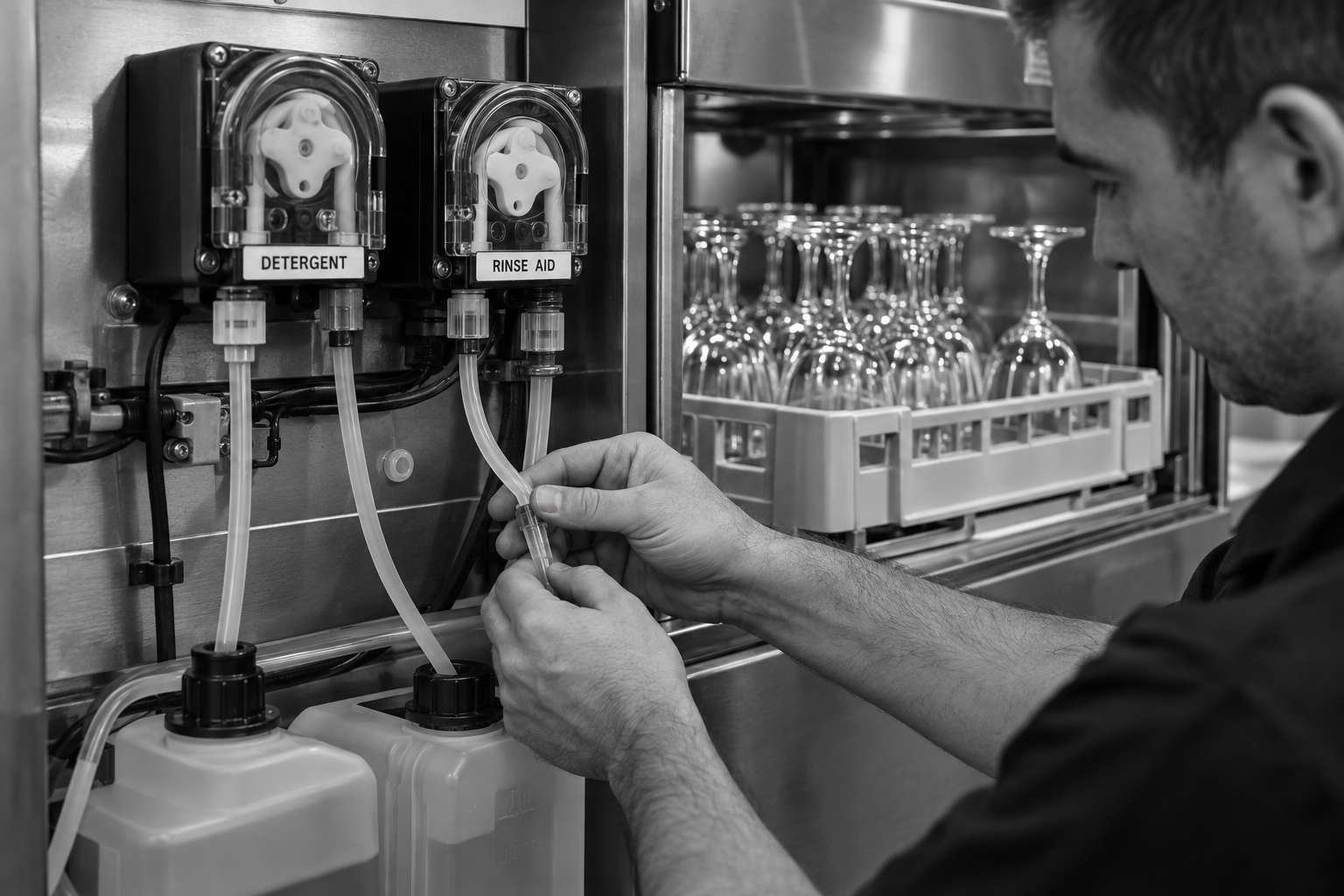
Commercial Glasswasher Chemical Dosing Problems
Using More Chemical but Getting Worse Results?
Your glasswasher completes its cycle.
But something isn't right.
Glasses are streaky.
They're covered in spots.
They're not drying properly.
There's a cloudy film.
Detergent or rinse aid seems to be disappearing unusually quickly — or the chemical container barely seems to move at all.
Staff keep adjusting the chemical settings, but the problem keeps coming back.
The glasswasher may not need more chemical. It may have a chemical dosing problem.
Worldwide CDM diagnoses commercial glasswasher detergent and rinse-aid dosing problems across Sydney.
With more than 30 years of commercial catering equipment experience, we look beyond the symptom to determine whether the problem involves chemical delivery, dosing equipment, water conditions, rinse performance or another part of the glasswashing process.
More Chemical Doesn't Automatically Mean Cleaner Glasses.
What Is Chemical Dosing in a Commercial Glasswasher?
Commercial glasswashing relies on several processes working together.
Water temperature, wash action, rinse performance, water quality and chemical concentration can all influence the final result.
Two chemicals commonly used in the process are:
Detergent
Commercial glasswasher detergent assists the wash process in removing contamination from glassware.
Too little detergent may contribute to poor cleaning.
Too much isn't automatically better and can contribute to residue, unnecessary chemical consumption and poor results if the overall washing and rinsing process isn't correctly balanced.
Rinse Aid
Rinse aid is introduced during the final rinse process and helps water drain from the surface of the glassware more effectively.
Incorrect rinse-aid delivery can contribute to problems such as:
Water spots
Streaking
Poor drying
Film
Uneven glass appearance
The objective isn't to maximise chemical use.
It's to achieve the correct chemical concentration for the equipment, product, water and operating conditions.
Signs Your Glasswasher May Have a Chemical Dosing Problem
Chemical dosing problems don't always produce an error code.
Instead, your staff may notice a change in glasswashing performance.
Common warning signs can include:
Glasses Suddenly Coming Out Cloudy
A film or cloudy appearance may involve detergent, rinse aid, water quality, scale or other wash and rinse conditions.
White Spots or Marks
White marks can involve mineral deposits and water hardness, but chemical dosing and rinse performance may also need to be considered.
Streaks Across Glassware
Incorrect rinse-aid concentration can contribute to streaking or an uneven finish.
Glasses Not Drying Properly
If excessive water remains on glassware after the cycle, rinse-aid delivery is one factor that may need investigation.
Poor Cleaning Results
If insufficient detergent is entering the wash process, cleaning performance may deteriorate.
However, poor cleaning doesn't automatically mean the machine simply needs more detergent.
Chemical Container Emptying Too Quickly
A sudden increase in detergent or rinse-aid consumption may indicate excessive dosing, an incorrect setting, a leak or another chemical-delivery problem.
Chemical Container Lasting Much Longer Than Normal
This can be just as important.
If a chemical container that normally requires regular replacement suddenly seems to last much longer while wash quality deteriorates, the chemical may not be entering the machine as expected.
No Visible Chemical Moving Through the Line
Depending on the dosing system and tubing, lack of expected chemical movement may indicate a delivery problem that requires investigation.
Why Has My Commercial Glasswasher Stopped Dosing Chemicals?
A dosing problem can have several possible causes.
Depending on the equipment and chemical system, areas that may need investigation include:
Empty detergent or rinse-aid containers
Chemical pickup tubes
Blocked chemical lines
Crystallised chemical within tubing
Split, hardened or damaged tubing
Air entering a chemical line
Poor priming
Dosing pump problems
Incorrect dosing settings
Chemical leaks
Incorrect chemical
Recent changes in chemical product
Electrical or control problems
Water conditions
Other machine-specific faults
The visible symptom doesn't necessarily identify which one is responsible.
Diagnose the Dosing System Before Continually Adjusting It.
Commercial Glasswasher Dosing Pump Problems
Some commercial glasswashers use dosing pumps to deliver detergent, rinse aid or both.
When the dosing system isn't operating correctly, the machine itself may still appear to run normally.
The wash pump can operate.
The machine can heat.
The rinse cycle can occur.
The cycle can finish.
But the expected amount of chemical may not be reaching the wash or rinse process.
That can make dosing faults easy to overlook.
Depending on the system, diagnosis may involve checking the relevant:
Dosing pump
Chemical tubing
Pickup lines
Connections
Priming
Chemical supply
Dosing settings
Electrical supply
Controls
Simply increasing a dosing setting won't fix a chemical pump or delivery system that isn't operating correctly.
Commercial Glasswasher Detergent Dosing Problems
Too Little Detergent
If insufficient detergent is being delivered, wash performance may deteriorate.
Staff might notice:
Lipstick remaining on glass rims
Drink residue
Greasy film
Fingerprints
Poor overall cleaning
Increasing numbers of glasses requiring rewashing
But detergent is only one part of the washing process.
Poor cleaning can also involve temperature, wash pressure, blocked jets, dirty filters, wash-water condition, loading or other equipment problems.
That's why poor cleaning should not automatically lead to the detergent setting being increased.
Can Too Much Detergent Cause Problems?
Yes.
More detergent doesn't necessarily mean better cleaning.
Excessive detergent can increase chemical consumption and may contribute to residue or poor finishing when the overall wash and rinse process isn't correctly balanced.
If staff continually increase detergent because glasses aren't coming out clean, they may be compensating for an entirely different fault.
For example, the underlying problem could involve:
Wash performance
Water temperature
Rinse performance
Blocked jets
Water conditions
Scale
Loading
Another mechanical or operating issue
Fix the Cause Instead of Compensating With More Chemical.
Commercial Glasswasher Rinse Aid Problems
Rinse aid helps water drain from glass surfaces during the final stages of glasswashing.
Incorrect rinse-aid dosing may contribute to:
Water spots
Streaks
Film
Poor drying
Uneven finish
Excessive droplets remaining on glassware
However, these symptoms don't automatically prove the rinse-aid system is responsible.
Rinse performance, water pressure, rinse temperature, water hardness and scale can produce similar symptoms.
That's why the whole process needs to be considered.
Can Too Much Rinse Aid Cause Problems?
Yes.
If glassware isn't drying properly or has visible marks, repeatedly increasing the rinse aid isn't necessarily the answer.
Both insufficient and excessive dosing can affect the finished result.
The appropriate concentration depends on factors including the chemical product, machine, water conditions and operating requirements.
If a machine previously produced clear glassware and the problem suddenly developed, identifying what changed is often more useful than immediately changing the dosing setting.
Did the Problem Start After Changing Chemicals?
Tell Us.
This is an important diagnostic clue.
Different detergent and rinse-aid products can have different formulations, concentrations and recommended dosing requirements.
A dosing arrangement suitable for one product may not necessarily be appropriate for another.
If glasswashing performance changed shortly after:
Changing detergent
Changing rinse aid
Changing chemical supplier
Replacing a chemical container
Adjusting dosing settings
Servicing the dosing system
tell the technician.
The timing may help narrow down the cause.
Blocked Glasswasher Chemical Dosing Lines
Chemical delivery depends on the chemical being able to travel from its container through the dosing system.
Depending on the system and circumstances, chemical lines can become restricted.
Problems may include:
Chemical deposits
Crystallisation
Kinked tubing
Damaged tubing
Blocked pickup points
Air entering the line
Incorrect installation or connection
A blocked line can mean the dosing pump is operating without the expected amount of chemical reaching the machine.
This is another reason simply changing the dosing setting may not solve the problem.
Damaged Glasswasher Chemical Tubing
Chemical tubing doesn't last forever.
Tubing can deteriorate with age, chemical exposure, heat, movement and normal use.
Depending on the type of system, damaged tubing may lead to:
Poor chemical delivery
Inconsistent dosing
Air entering the system
Chemical leakage
Loss of prime
Increased or reduced chemical consumption
Chemical leaks should be dealt with carefully because commercial cleaning chemicals can be hazardous.
Avoid direct contact and follow the chemical supplier's safety instructions.
Why Does My Glasswasher Keep Losing Prime?
If chemical isn't being drawn through the dosing system correctly, the line may fail to remain primed.
Possible causes can include:
Empty chemical container
Pickup tube problems
Air leaks
Damaged tubing
Loose connections
Dosing pump problems
Blockages
Other system-specific issues
Repeatedly priming a system without identifying why it keeps losing prime may only temporarily mask the problem.
My Glasswasher Is Using Too Much Detergent or Rinse Aid
Unexpectedly high chemical consumption costs money.
If detergent or rinse aid is disappearing much faster than usual, don't assume that's simply what the machine requires.
Possible factors may include:
Excessive dosing
Incorrect settings
Leakage
Chemical delivery problems
Incorrect setup
Changes to the chemical product
Changes in operating conditions
Chemical usage should be considered alongside the quality of the finished glassware.
If chemical consumption has increased while results have become worse, that is particularly worth investigating.
My Glasswasher Isn't Using Any Detergent or Rinse Aid
The opposite problem can occur.
If a chemical container barely changes over time and glasswashing performance has deteriorated, check whether the chemical is actually being delivered.
Depending on the equipment, possible causes may involve:
Dosing pump operation
Blocked lines
Pickup tubes
Damaged tubing
Priming
Settings
Controls
Chemical supply
A machine can complete a normal-looking cycle even when the chemical dosing process isn't operating as intended.
Chemical Dosing or Hard Water?
They Can Look Like the Same Problem.
This is where glasswasher diagnosis becomes more complicated.
Cloudiness, white marks and poor glass appearance aren't always caused by chemicals.
Hard water contains dissolved minerals that can leave deposits as water evaporates.
Hard-water conditions can also contribute to scale accumulation inside the glasswasher.
That means repeatedly changing detergent or rinse-aid settings may not solve the problem if the underlying issue is water quality or water treatment.
Where relevant, the following may need consideration:
Water hardness
Water softener operation
Salt levels
Water treatment
Scale accumulation
Chemical suitability for the water conditions
Don't Try to Fix a Water Problem With More Chemical.
Chemical Dosing or Poor Rinsing?
Another common diagnostic mistake is assuming visible chemical residue automatically means too much detergent.
The actual problem could be that the detergent isn't being rinsed away effectively.
Poor rinsing can involve:
Restricted rinse jets
Blocked rinse arms
Water-pressure problems
Water-supply restrictions
Rinse valve faults
Rinse pump problems
Temperature problems
Scale
Other rinse-system faults
This is why we look at the entire glasswashing process rather than one setting in isolation.
Having rinse problems too?
Troubleshoot Commercial Glasswasher Not Rinsing Properly →
Chemical Dosing or a Cleaning Problem?
If glasses are coming out dirty, chemical concentration is only one possible cause.
The wash system itself may need attention.
Problems can involve:
Wash jets
Wash arms
Filters
Wash pump
Temperature
Water level
Wash-water condition
Loading
Scale
Chemical dosing
Glasses still coming out dirty?
Troubleshoot Commercial Glasswasher Not Cleaning Properly →
Chemical Dosing and Cloudy Glasses
Cloudiness deserves its own diagnosis because several very different problems can look similar.
Possible causes include:
Detergent concentration
Rinse-aid concentration
Hard water
Mineral deposits
Scale
Poor rinsing
Water treatment
Glassware deterioration
Permanent glass etching
A removable film and permanent damage to the glass surface aren't the same thing.
Before continually adjusting chemicals, determine what you're actually seeing.
Seeing cloudy glassware?
Troubleshoot Commercial Glasswasher Leaving Glasses Cloudy →
What Staff Can Check Before Calling for Service
Before booking a technician, there are several basic observations that may help.
Check the Chemical Containers
Are the detergent and rinse-aid containers empty?
Check the Pickup Tubes
Are they actually sitting in the correct chemical container?
Look for Obvious Tubing Problems
Without dismantling the machine, look for visible disconnected, kinked or damaged external chemical lines.
Think About What Recently Changed
Did the problem begin after changing chemicals, replacing a container or adjusting the machine?
Look at the Glassware
Is it:
Dirty?
Cloudy?
Streaked?
Spotted?
Wet?
Covered in residue?
Different symptoms provide different clues.
Check Whether Every Rack Is Affected
Consistent problems across every rack can point in a different direction from poor results affecting only certain rack positions.
Don't Randomly Adjust Internal Settings.
If you don't know the correct dosing requirements, repeatedly changing settings can make the original problem harder to diagnose.
How We Diagnose Commercial Glasswasher Dosing Problems
1. Tell Us What Changed
Tell us what the glassware looks like, whether chemical consumption has changed and whether anything happened shortly before the problem began.
Click here to provide us with the details.
2. We Assess the Relevant Systems
Depending on the symptoms and machine, this may include the relevant:
Chemical supply
Dosing pumps
Chemical lines
Tubing
Pickup system
Priming
Dosing settings
Wash performance
Rinse performance
Water conditions
Heating
Controls
3. We Identify the Actual Cause
A dosing problem shouldn't automatically become a dosing-pump replacement.
The problem may be a blocked line.
It may be damaged tubing.
It may be an incorrect setting.
It may be the chemical itself.
Or chemical dosing may not be the primary problem at all.
4. We Explain What We've Found
We'll explain what's causing the problem and what needs attention.
5. We Repair What's Required
If a glasswasher component requires repair or replacement, we'll recommend the appropriate action.
If the problem is related to chemicals, water treatment or operating conditions rather than a failed machine component, we'll tell you that too.
We Find the Fault Before We Sell the Fix.
Why Correct Diagnosis Matters
Imagine glasses suddenly start coming out streaky.
The immediate reaction might be:
"Turn the rinse aid up."
But what if the actual problem is poor rinse pressure?
Or a dosing line?
Or the chemical was recently changed?
Or the water conditions are contributing to the marks?
Increasing one setting can change the symptom without addressing the cause.
That's why our approach is based on diagnosis rather than trial and error.
Test. Diagnose. Then Repair or Adjust What Actually Requires Attention.
Commercial Glasswasher Dosing Problems Across Sydney
Worldwide CDM diagnoses and repairs commercial glasswasher performance and chemical dosing problems for:
Restaurants
Bars
Pubs
Clubs
Hotels
Cafés
Function centres
Catering businesses
Commercial kitchens
Hospitality venues
We provide commercial glasswasher repairs throughout Sydney and surrounding service areas.
More Than 30 Years of Commercial Equipment Experience
Worldwide CDM is a family-run commercial catering equipment business with more than 30 years of experience supporting hospitality businesses.
We understand how disruptive poor glasswashing performance can become during service.
Staff shouldn't have to keep rewashing racks, polishing glasses or experimenting with chemical settings while clean glassware runs short.
Our approach is straightforward:
Understand the symptom.
Assess the system.
Identify the cause.
Explain what's wrong.
Repair what actually requires attention.
We Find the Fault Before We Sell the Fix.
Frequently Asked Questions
Why isn't my commercial glasswasher using detergent?
Possible causes can include an empty chemical container, pickup problems, blocked or damaged tubing, loss of prime, a dosing pump problem, incorrect settings or a control issue. The dosing system should be checked to identify the cause.
Why isn't my commercial glasswasher using rinse aid?
Possible causes include chemical supply problems, blocked or damaged lines, poor priming, dosing equipment problems, settings or controls.
Can too much detergent make glasses cloudy?
Incorrect detergent concentration can contribute to film or residue, but cloudy glasses can also result from water hardness, mineral deposits, rinse-aid problems, poor rinsing, scale or permanent glass damage.
Can too much rinse aid cause streaks?
Incorrect rinse-aid concentration can contribute to streaks and other poor finishing results. More rinse aid isn't automatically better.
Why is my glasswasher using so much chemical?
High chemical consumption may involve excessive dosing, incorrect settings, leakage, chemical setup or changes in the product or operating conditions. A sudden change in consumption is worth investigating.
Why has my glasswasher stopped drawing chemical?
Possible causes can include an empty container, blocked pickup or dosing line, damaged tubing, loss of prime, a dosing pump fault, settings or controls.
Should I turn the detergent up if glasses aren't clean?
Not automatically. Poor cleaning can also involve wash pressure, blocked jets, temperature, water condition, filters, loading, scale or another machine problem. Determine the cause before changing the chemical concentration.
Should I increase rinse aid if glasses aren't drying?
Not automatically. Rinse aid is one factor, but poor drying or water remaining on glasses may also involve rinse performance, temperature, water quality or other conditions.
Can changing chemical brands affect glasswasher performance?
Yes. Different products can have different concentrations and dosing requirements. If performance changed immediately after changing detergent or rinse aid, the new chemical and dosing setup should be considered.
Can hard water look like a chemical dosing problem?
Yes. Mineral deposits can create white marks, spotting or cloudiness that may be mistaken for a chemical problem. Water conditions and water treatment should be considered as part of diagnosis.
Do you repair commercial glasswasher dosing problems in Sydney?
Yes. Worldwide CDM diagnoses commercial glasswasher chemical dosing and related wash, rinse and equipment problems across Sydney on the commercial equipment brands we service.
Commercial Glasswasher Chemical Dosing Problem?
Stop Chasing the Setting. Find the Cause.
Your staff need clean, clear, presentation-ready glassware — not another setting to experiment with.
If your glasswasher has suddenly started producing cloudy, streaky, spotted, wet or poorly cleaned glasses, tell us what's happening.
Worldwide CDM can investigate whether the problem involves detergent, rinse aid, dosing equipment, chemical delivery, wash performance, rinse performance, water conditions or another part of the glasswasher.
30+ Years' Commercial Equipment Experience
Commercial Glasswasher Fault Diagnosis
Sydney Service
Family Owned
Straightforward Advice
We Find the Fault Before We Sell the Fix.
Keep Serving Customers With Confidence.
Related Commercial Catering Equipment Repairs
Worldwide CDM also provides professional repairs for: