
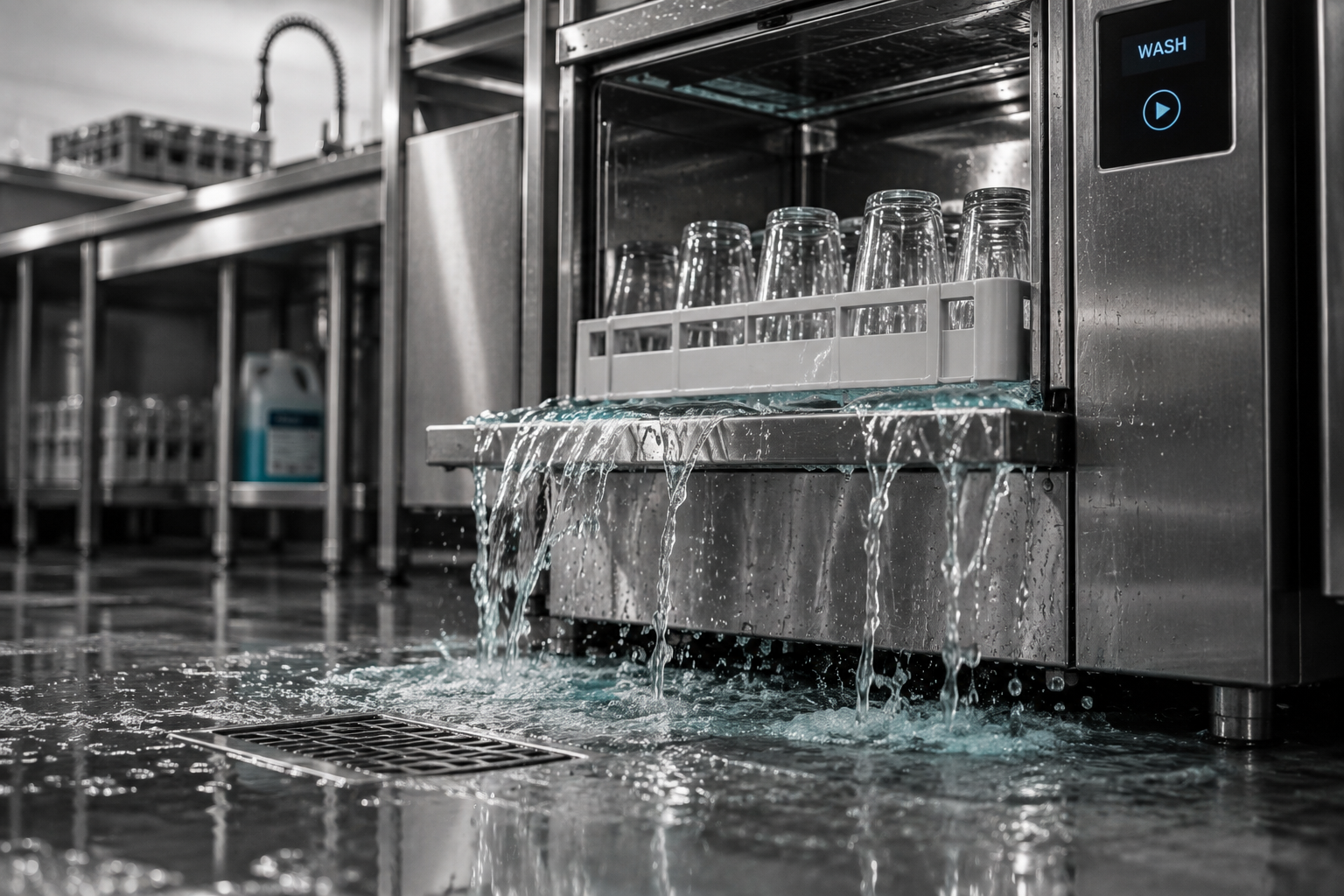
Commercial Glasswasher Overflowing?
Too Much Water in the Machine? Find Out Why Before It Happens Again.
The water level keeps rising.
Water spills from the machine.
The glasswasher doesn't seem to stop filling.
Or everything looks normal until suddenly there's water across the floor.
Your staff can mop it up.
They can restart the machine.
But neither explains why the glasswasher has too much water in it.
An overflowing commercial glasswasher can involve the filling system, water-level control, drainage or another related fault.
Worldwide CDM diagnoses and repairs overflowing commercial glasswashers across Sydney.
With more than 30 years of commercial catering equipment experience, we investigate why the water level has become abnormal before recommending what needs to be repaired.
Don't Just Stop the Overflow. Find Out What Caused It.
Why Is My Commercial Glasswasher Overflowing?
A commercial glasswasher is designed to control how much water enters, remains in and leaves the machine.
When that process isn't working correctly, the water level may become too high.
Depending on the glasswasher design and symptoms, possible causes can include:
Water-level sensing problems
Pressure-system problems
Water inlet valve faults
Filling-system problems
Drainage restrictions
Blocked filters
Blocked or restricted drain hoses
Drain pump problems
Incorrectly positioned or obstructed components
Electrical or control faults
Excessive foaming
Installation or waste-system problems
The exact components vary between machines.
That's why:
"It's Overflowing" Is the Symptom. We Still Need to Find the Cause.
Is My Glasswasher Overflowing or Leaking?
This distinction matters.
An Overflow
An overflow generally involves too much water, foam or liquid reaching somewhere it shouldn't because water level, filling, drainage or another process isn't operating normally.
A Leak
A leak may occur even when the water level inside the machine is normal.
Possible leak sources can include:
Hoses
Connections
Seals
Pumps
Valves
Internal plumbing
Door or hood areas
The two problems can look almost identical once the water reaches the floor.
That's why the puddle itself doesn't tell you what failed.
Water level normal but the machine is still leaking?
Troubleshoot Commercial Glasswasher Leaking Water →
Commercial Glasswasher Keeps Filling With Water
Does the Water Keep Coming In?
A glasswasher should control its filling process.
If water continues entering when it shouldn't, the filling and water-level systems may need investigation.
Depending on the machine, possible areas can include:
Water inlet valve
Solenoid valve
Water-level sensor
Pressure switch or pressure system
Associated tubing
Controls
Wiring
Other machine-specific filling components
The key question is:
Does the Machine Know It Has Enough Water?
If the system responsible for detecting or controlling water level isn't operating correctly, filling may not stop when expected.
Commercial Glasswasher Water Level Too High
A glasswasher doesn't necessarily need to pour water onto the floor before there is a problem.
An unusually high water level inside the machine may be an earlier warning sign.
Staff may notice:
Water sitting higher than normal
Water approaching the door or opening
Water escaping during a cycle
Unusual splashing
Poor wash performance
Slow draining
Water remaining after a cycle
Intermittent overflowing
If the normal water level has changed, investigate why rather than treating the higher level as normal operation.
Commercial Glasswasher Water-Level Sensor Problems
Commercial glasswashers use machine-specific systems to determine or control water level.
Depending on the design, these may include pressure-based systems, switches, sensors or other controls.
If the water-level system isn't correctly detecting conditions inside the machine, filling behaviour can become abnormal.
Possible symptoms can include:
Overfilling
Underfilling
Filling that doesn't stop
Intermittent filling problems
Abnormal water levels
Cycle problems
However, abnormal filling doesn't automatically mean the sensor itself has failed.
Associated tubing, pressure conditions, wiring, controls or other components may be responsible.
Test the System Before Replacing the Sensor.
Commercial Glasswasher Pressure Switch Problems
Some commercial warewashing equipment uses pressure-related systems as part of water-level control.
If the machine isn't correctly detecting its water level, relevant components may need inspection.
But replacing a pressure switch based solely on an overflowing symptom can be premature.
The problem may instead involve:
Associated tubing
Blockages
Air leaks
Connections
Water-level conditions
Electrical connections
Controls
Another part of the filling system
Correct diagnosis means testing the system rather than guessing which component has failed.
Commercial Glasswasher Inlet Valve Problems
The inlet valve controls incoming water.
Depending on the machine and fault, an inlet valve that isn't operating as intended can contribute to abnormal filling.
One useful diagnostic observation is when water enters the machine.
For example:
Does it only overfill while switched on?
Does water continue entering after the expected fill has finished?
Does the water level rise while the machine is sitting idle?
These details can help narrow down the problem.
Tell Us Exactly When the Water Starts Rising.
Why Does My Glasswasher Fill With Water When It's Turned Off?
If the water level rises while the machine isn't actively calling for water, stop treating it as a normal filling cycle.
Depending on the equipment, the incoming-water system may require investigation.
A valve that isn't closing correctly is one possible cause, although diagnosis is required before assuming a particular component has failed.
If water continues entering unexpectedly, arrange for the equipment to be inspected.
Can a Blocked Drain Make a Glasswasher Overflow?
Yes, drainage problems can contribute to abnormal water levels.
Think of the system as two sides:
Water needs to enter correctly.
and
Water needs to leave correctly.
If the machine can't remove water as intended, subsequent filling or operating cycles may result in an abnormal water level.
Possible drainage problems can include:
Blocked filters
Drain restrictions
Kinked or obstructed drain hose
Drain pump problems
Drain valve problems
Waste connection issues
Internal blockages
This is why an overflowing glasswasher isn't automatically a filling problem.
Sometimes the machine is receiving the correct amount of water but isn't getting rid of it correctly.
Water remaining inside the machine?
Troubleshoot Commercial Glasswasher Not Draining →
Glasswasher Overflowing During the Wash Cycle
Does the machine fill normally but water begins escaping once washing starts?
That's an important distinction.
Possible factors may include:
Excessive water level
Excessive foaming
Abnormal spray direction
Wash-arm problems
Door or hood sealing
Loading
Drainage problems
Other wash-system conditions
The machine may therefore appear to be "overflowing" even though the original problem occurred earlier in the cycle.
Knowing exactly when water first escapes can make diagnosis considerably easier.
Glasswasher Overflowing During Filling
If water escapes while the glasswasher is actively filling, the water-level and inlet systems become particularly relevant.
Questions that help include:
Does filling stop at all?
Does it fill much longer than normal?
Does the water level continue rising?
Is the problem intermittent?
Did the problem begin suddenly?
Has anything recently been repaired or adjusted?
Tell the technician what you've observed rather than trying to identify the component yourself.
Glasswasher Overflowing During Draining
An apparent overflow during draining may indicate a different problem.
Water may be backing up because it cannot move through the drainage or waste system correctly.
Potential areas for investigation can include:
Drain hose
Drain pump
Drain valve
Waste connection
Restrictions
Blockages
Installation
It is also important to determine whether the water is actually overflowing from the machine or backing up from an external waste connection.
Why Does My Glasswasher Overflow Intermittently?
Intermittent Problems Still Have Causes.
A machine that overflows once and then operates normally for ten cycles can be particularly difficult for staff to understand.
Don't dismiss the problem simply because it disappeared.
Intermittent behaviour may relate to changing operating conditions or a component that isn't behaving consistently.
Useful information includes:
Which stage of the cycle it occurs in
Whether the machine was heavily used beforehand
Whether water was already inside it
Whether it had drained completely
Whether excessive foam was present
Whether it happens after particular racks
Whether restarting the machine changes anything
These details can help recreate and diagnose the fault.
Could Excessive Foam Make My Glasswasher Overflow?
Potentially.
A machine filled with foam can appear to be overflowing even when the underlying problem involves chemicals rather than water-level control.
Commercial glasswashers require appropriate commercial chemicals and suitable dosing.
Excessive foaming may be associated with:
Unsuitable detergent
Excessive chemical dosing
Chemical contamination
Incorrect product
Residue introduced with glassware
Other operating conditions
If the overflow started after changing chemicals or adjusting dosing, tell the technician.
Don't Try to Solve Foam by Adding More Chemical.
Seeing unusual chemical consumption or excessive foam?
Troubleshoot Commercial Glasswasher Chemical Dosing Problems →
Can Hand Dishwashing Liquid Make a Commercial Glasswasher Foam?
Hand dishwashing detergents are designed to produce foam and generally aren't intended for use as commercial glasswasher machine detergent.
Introducing a high-foaming product into a commercial glasswasher can interfere with normal operation and create large amounts of foam.
Use chemicals intended for the equipment and follow the chemical and equipment suppliers' instructions.
If an unsuitable chemical has accidentally been introduced, don't keep running cycles in the hope that the problem will disappear.
Why Does My Glasswasher Overflow After Several Cycles?
This is useful information for diagnosis.
If the machine starts normally but the water level becomes abnormal after repeated cycles, consider whether:
Water is draining correctly
The water level is returning to normal
Foam is accumulating
The problem occurs at a particular cycle stage
The machine is behaving differently as operation continues
Don't assume the machine is fine because the first cycle works correctly.
Tell us how the behaviour changes over time.
Glasswasher Filling and Draining at the Same Time
If the machine appears to be taking in and losing water unexpectedly, the filling, drainage and water-level systems may need investigation.
The exact sequence of filling and draining varies between glasswasher designs, so what is normal for one machine isn't necessarily normal for another.
Rather than assuming a component is faulty based on the sound of running water, look for other signs such as:
Abnormal water level
Continuous filling
Poor cleaning
Long cycle times
Water remaining in the machine
Water escaping onto the floor
Machine-specific diagnosis is important.
Is an Overflowing Glasswasher Dangerous?
Escaping water in a commercial kitchen or bar should not be ignored.
Depending on the severity and location, overflowing water can contribute to:
Slip hazards
Water reaching electrical components
Damage to surrounding equipment
Damage to flooring or cabinetry
Corrosion
Operational disruption
Further equipment damage
If water is creating an electrical or workplace safety hazard, stop using the equipment and follow appropriate workplace safety procedures.
Should I Keep Using an Overflowing Glasswasher?
If a glasswasher is repeatedly overflowing, continuing to operate it without understanding the cause isn't a good solution.
A recurring overflow means something about the machine's water, drainage, chemical or operating conditions requires attention.
Repeatedly:
mopping the floor → restarting the machine → running another rack
doesn't repair the underlying fault.
Stop Managing the Symptom and Find the Cause.
What Staff Can Check Before Calling a Technician
You don't need to dismantle the glasswasher.
A few simple observations can provide valuable diagnostic information.
When Does It Overflow?
During filling?
Washing?
Rinsing?
Draining?
After several cycles?
While switched off?
Is the Water Level Higher Than Normal?
If you know what the normal operating level looks like, tell us whether it has changed.
Is the Machine Draining?
Does water remain after the cycle?
Is There Excessive Foam?
Foam points the investigation in a different direction.
Is Water Still Entering?
Does the machine appear to continue filling after it should have stopped?
Did Anything Change Recently?
For example:
Chemical product
Dosing adjustment
Plumbing work
Machine relocation
Service or repair
Drainage work
These details can help.
Don't Start Replacing Parts Based on the Symptom
An overflowing glasswasher may look like a simple water-level sensor problem.
But several systems can influence the final water level.
For example:
The machine could be taking in too much water.
Or it could be failing to detect the correct water level.
Or it could be failing to drain the previous water correctly.
Or excessive foam could be escaping from a machine with an otherwise normal water level.
Those scenarios don't require the same repair.
Same Symptom. Different Causes.
That's why diagnosis comes first.
How We Diagnose an Overflowing Commercial Glasswasher
1. Tell Us What Happens
If possible, provide:
Brand
Model
When the machine overflows
Whether it continues filling
Whether it drains
Whether the water level looks unusually high
Whether there is excessive foam
Whether the problem is constant or intermittent
When the problem started
You don't need to know which component is faulty.
2. We Assess the Relevant Systems
Depending on the symptoms and equipment, diagnosis may involve checking relevant:
Water-level systems
Pressure systems
Inlet valves
Filling components
Drain pumps
Drain valves
Filters
Drain hoses
Waste connections
Chemical conditions
Wiring
Controls
Related components
3. We Identify Why the Water Level Is Abnormal
The objective isn't simply to stop water reaching the floor.
It's to determine why it got there.
4. We Explain What We've Found
Once the fault is identified, we'll explain what requires attention.
5. We Repair What's Required
Where a repair is required, we address the relevant fault rather than replacing parts based solely on the visible symptom.
We Find the Fault Before We Sell the Fix.
Why Correct Diagnosis Can Save You Money
Imagine a glasswasher keeps overflowing.
Someone assumes:
"The water-level switch must be faulty."
A new switch is fitted.
But the machine overflows again.
Why?
Because the actual problem was elsewhere in the water-level, filling or drainage system.
Replacing parts through trial and error can increase repair costs without solving the original problem.
Our approach is different:
Diagnose First. Replace Second.
Commercial Glasswasher Brands We Repair
Worldwide CDM diagnoses and repairs faults across many commercial glasswasher brands used throughout Sydney hospitality venues, including:
Contact us with your glasswasher brand, model and a description of where the water is appearing.
Commercial Glasswasher Overflow Repairs Across Sydney
Worldwide CDM provides commercial glasswasher fault diagnosis, servicing and repairs for:
Restaurants
Bars
Pubs
Clubs
Hotels
Cafés
Function centres
Catering businesses
Commercial kitchens
Hospitality venues
We service commercial customers throughout Sydney and surrounding service areas.
More Than 30 Years of Commercial Equipment Experience
An overflowing glasswasher can quickly turn from an equipment problem into an operational problem.
Your staff shouldn't spend service repeatedly mopping water from around the machine and hoping the next cycle works.
Worldwide CDM is a family-run commercial catering equipment business with more than 30 years of experience supporting Sydney hospitality businesses.
Our approach is straightforward:
Understand what's happening.
Assess the relevant systems.
Identify the cause.
Explain the problem.
Repair what's required.
We Find the Fault Before We Sell the Fix.
Related Commercial Glasswasher Problems
An overflowing glasswasher can share symptoms with several other faults.
Commercial Glasswasher Leaking Water
Water level appears normal, but water is escaping from the machine?
Troubleshoot Commercial Glasswasher Leaking Water →
Commercial Glasswasher Not Draining
Water is remaining inside the machine after the cycle?
Troubleshoot Commercial Glasswasher Not Draining →
Commercial Glasswasher Not Filling With Water
Machine won't fill, fills slowly or has inconsistent water levels?
Troubleshoot Commercial Glasswasher Not Filling →
Commercial Glasswasher Chemical Dosing Problems
Excessive foam or unusual detergent/rinse-aid behaviour?
Troubleshoot Commercial Glasswasher Chemical Dosing Problems →
Frequently Asked Questions
Why is my commercial glasswasher overflowing?
Possible causes can include abnormal filling, water-level sensing problems, inlet valve faults, pressure-system problems, drainage restrictions, drain pump faults, excessive foaming or associated controls. Diagnosis is required because several faults can produce the same symptom.
Why won't my glasswasher stop filling with water?
The filling system may not be stopping incoming water as expected. Depending on the machine, the inlet valve, water-level system, pressure system, wiring or controls may need investigation.
Why is the water level too high in my commercial glasswasher?
A high water level can involve the filling system, water-level sensing, drainage or other machine-specific controls. It is important to determine whether too much water is entering or whether existing water isn't leaving correctly.
Can a blocked drain make my glasswasher overflow?
Yes. If water cannot leave the machine correctly, drainage problems can contribute to abnormal water levels. Possible causes include restrictions, filters, hoses, pumps, valves or waste connections.
Why does my glasswasher overflow only sometimes?
Intermittent overflowing can depend on the stage of operation, drainage, water-level control, filling behaviour, foaming or other changing conditions. Note when it happens and what the machine was doing immediately beforehand.
Why does my glasswasher overflow during the wash cycle?
Possible causes include excessive water level, excessive foaming, abnormal spray direction, wash-system problems or sealing issues. The point in the cycle when the overflow starts is useful diagnostic information.
Why does my glasswasher fill with water when switched off?
Unexpected water entering while the machine isn't actively filling can indicate an incoming-water control problem that requires investigation. An inlet valve is one possible area to assess, but the fault should be confirmed before replacement.
Can too much detergent make a commercial glasswasher overflow?
Incorrect or unsuitable chemicals can create excessive foaming, which may escape from the machine and resemble an overflow. Commercial glasswashers should use suitable low-foaming chemicals according to the appropriate equipment and chemical requirements.
Is my glasswasher overflowing or leaking?
If the machine contains too much water or foam, it may be overflowing. If the internal water level is normal but water escapes through a hose, connection, seal, pump or other component, it may be leaking. Inspection may be needed to distinguish between them.
Should I keep using my glasswasher if it is overflowing?
A recurring overflow shouldn't be ignored. Escaping water can create slip hazards and potentially reach electrical components or surrounding equipment. If the situation presents a safety risk, stop using the machine and follow appropriate workplace procedures.
Do you repair overflowing commercial glasswashers in Sydney?
Yes. Worldwide CDM diagnoses and repairs commercial glasswasher filling, drainage, water-level and related faults across Sydney for the commercial equipment brands we service.
What information should I provide when booking?
Tell us the glasswasher brand and model if known, when the overflow occurs, whether the machine continues filling, whether it drains correctly, whether the water level is unusually high and whether excessive foam is present.
Commercial Glasswasher Overflowing?
Stop Mopping Up the Problem. Find Out Why It's Happening.
When water starts escaping from a glasswasher, your staff shouldn't have to spend service managing the machine instead of serving customers.
Whether the glasswasher is overfilling, failing to drain, producing excessive foam or experiencing another water-level problem, the solution starts with determining what's actually happening.
Worldwide CDM can diagnose the fault and determine what the machine requires.
30+ Years' Commercial Equipment Experience
Commercial Glasswasher Fault Diagnosis
Sydney Service
Family Owned
Commercial Equipment Specialists
Straightforward Advice
Don't Just Stop the Water. Find the Cause.
Keep Serving Customers With Confidence.
Click Here To Book A Service
Click Here To Call For Urgent Repairs
Related Commercial Catering Equipment Repairs
Worldwide CDM also provides professional repairs for: