
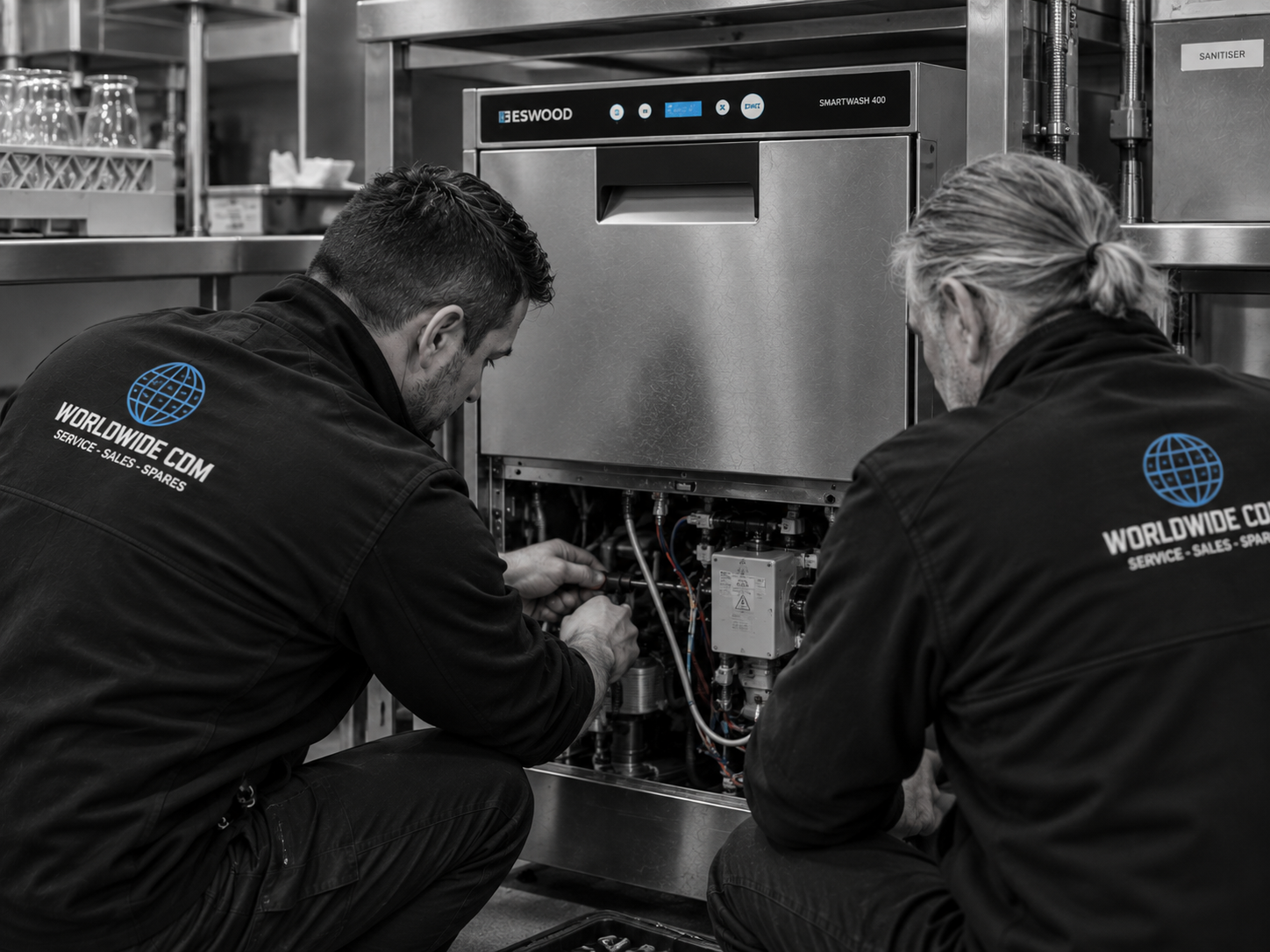
Commercial Glasswasher Taking Too Long to Heat?
Still Heating — Just Much Slower Than It Used To?
The glasswasher turns on.
It fills.
The temperature starts climbing.
But your staff are waiting.
And waiting.
A machine that once became ready quickly now seems to take much longer.
Maybe morning start-up is delaying service.
Maybe the temperature struggles to recover after repeated cycles.
Or perhaps the glasswasher eventually reaches operating temperature — but only after an unusually long wait.
Slow heating can be an early sign that something isn't operating as it should.
Worldwide CDM diagnoses commercial glasswashers taking too long to heat across Sydney.
With more than 30 years of commercial catering equipment experience, we investigate what's slowing the heating process before recommending what actually needs attention.
Don't Wait Until Slow Heating Becomes No Heating.
Why Is My Commercial Glasswasher Taking So Long to Heat?
A commercial glasswasher relies on several systems working together to heat and maintain water at the temperatures required by its particular operating cycle.
If warm-up suddenly becomes slower than normal, possible causes can include:
Scale on heating surfaces
Heating element problems
Electrical supply problems
Contactor or relay problems
Thermostat problems
Temperature sensor problems
Water-level problems
Excessive incoming cold water
Filling-system problems
Booster heating problems
Control problems
Other machine-specific faults
The exact heating arrangement varies between commercial glasswasher brands and models.
That's why:
Slow Heating Is the Symptom. The Cause Still Needs to Be Found.
Is Slow Heating Actually a Problem?
Not every glasswasher reaches temperature in the same amount of time.
Normal warm-up depends on factors including:
Glasswasher model
Heating capacity
Incoming water temperature
Electrical configuration
Tank capacity
Booster arrangement
Ambient conditions
Operating sequence
So there isn't one universal warm-up time that applies to every commercial glasswasher.
What matters is a change from the machine's normal behaviour.
If your glasswasher consistently reached operating temperature within its usual timeframe and now takes significantly longer under similar conditions, that change is worth investigating.
Compare the Machine to Its Normal Performance — Not Someone Else's Machine.
Commercial Glasswasher Slow to Heat From Cold
Morning start-up can make a developing heating problem particularly obvious.
Staff may notice:
"It used to be ready before we opened."
Now the temperature climbs slowly and the machine isn't ready when service starts.
Possible areas for investigation can include:
Heating elements
Scale
Electrical supply
Heating controls
Temperature sensing
Incoming water conditions
Water level
Booster system
If warm-up has gradually become slower over weeks or months, tell the technician.
The timeline can provide useful diagnostic information.
Glasswasher Heats Eventually but Takes Too Long
This is different from a glasswasher that doesn't heat at all.
A completely failed heating component may result in no meaningful temperature increase.
But partial or intermittent problems can create a different symptom:
The Machine Still Heats — Just Poorly.
Depending on the equipment, this may occur when:
Heating performance is reduced
One part of a multi-element heating arrangement isn't operating
Scale is insulating a heating surface
Electrical components aren't operating correctly
Water conditions have changed
The machine is repeatedly introducing colder water
Temperature sensing or controls aren't behaving normally
This is why "it still heats" doesn't necessarily mean the heating system is healthy.
Commercial Glasswasher Heating Element Problems
Heating elements convert electrical energy into heat.
Depending on the machine, heating elements may be used for the wash tank, rinse/booster system or both.
A heating element doesn't always need to result in a completely cold machine for there to be a heating problem.
Where a machine uses multiple heating elements or heating circuits, reduced heating capacity may potentially result in longer warm-up or recovery times.
Diagnosis may involve assessment of relevant:
Heating elements
Electrical supply
Wiring
Connections
Contactors
Relays
Controls
Test the Heating Circuit Before Replacing the Element.
Suspect a heating element fault?
Troubleshoot Commercial Glasswasher Heating Element Problems →
Can Scale Make a Glasswasher Take Longer to Heat?
Yes.
Scale can accumulate on surfaces exposed to heated hard water.
When mineral deposits build up on heating surfaces, they can interfere with efficient heat transfer between the heating element and the surrounding water.
This means the equipment may need to operate for longer to achieve the required temperature.
Heavy scale can also contribute to problems elsewhere in the water system.
If your glasswasher has:
Become slower to heat
Developed visible scale
Started leaving mineral deposits
Developed cloudy glassware
water hardness and water treatment are worth investigating alongside the heating system.
Don't Just Remove the Scale. Find Out Why It Formed.
Scale keeps returning?
Troubleshoot Commercial Glasswasher Water Softener Problems →
Slow Heating and Hard Water
If a commercial glasswasher operates in hard-water conditions without suitable water treatment, mineral deposits can develop over time.
This can create a pattern where:
Machine heats normally
↓
Scale gradually accumulates
↓
Heat transfer becomes less efficient
↓
Warm-up takes longer
↓
Other scale-related problems begin appearing
Descaling may remove existing deposits where appropriate.
But if the underlying water conditions remain unchanged, scale can return.
That's why recurring scale should be considered as a water-treatment issue as well as a cleaning issue.
Commercial Glasswasher Booster Taking Too Long to Heat
Depending on the machine, the rinse system may include a booster or boiler used to heat rinse water.
If the wash tank reaches temperature normally but the machine waits unusually long for the rinse system, the booster side may require investigation.
Possible areas can include:
Booster heating element
Scale
Thermostat
Temperature sensor
Electrical supply
Contactors
Relays
Water supply
Controls
Other machine-specific components
The important clue is:
Which Temperature Is Taking Too Long to Rise?
Tell us whether the problem appears to involve the wash tank, rinse/booster temperature or the entire machine.
Glasswasher Slow to Recover Between Cycles
Sometimes initial warm-up seems normal.
The problem appears during service.
Your team runs several racks.
Then the machine begins taking longer before it's ready for the next cycle.
This may indicate a temperature recovery problem rather than an initial warm-up problem.
Possible factors can include:
Heating capacity
Booster performance
Incoming water temperature
Electrical heating components
Scale
High water replacement
Filling behaviour
Heavy usage
Controls
A commercial glasswasher should be assessed under the conditions in which the problem occurs.
Tell Us Whether It Happens at Start-Up or During Service.
Why Does My Glasswasher Heat Normally in the Morning but Struggle During Service?
This is an important diagnostic clue.
A machine sitting undisturbed may have enough time to reach temperature.
Repeated cycles place greater demand on its heating and recovery systems.
A developing heating problem may therefore become more obvious during peak operation.
If the problem only appears after:
Several consecutive racks
Busy lunch service
Busy dinner service
Heavy bar service
tell the technician.
That operating pattern can help distinguish slow initial heating from poor recovery.
Could Cold Incoming Water Make My Glasswasher Heat Slowly?
Incoming water temperature can influence how much heating the machine needs to perform.
The required water-supply conditions depend on the particular glasswasher.
If incoming water is substantially colder than the equipment is designed or configured for, warm-up or recovery may take longer.
Possible reasons for a change may include:
Plumbing changes
Hot-water supply problems
Machine connected to an unexpected supply
Changes elsewhere in the building
Other water-supply conditions
Check the manufacturer's installation requirements for the specific machine rather than assuming every glasswasher requires the same inlet temperature.
Glasswasher Taking Too Long to Heat After Filling
If the problem appears immediately after filling, it can be useful to consider both:
How much water entered
and
What temperature that water was.
Abnormal filling may increase the amount of water the machine has to heat.
A water-level problem may therefore sometimes look like a heating problem.
Relevant systems can include:
Water-level sensing
Pressure systems
Inlet valve
Filling controls
Drainage
Other machine-specific components
More Water Takes More Energy to Heat.
If the machine's water level has changed at the same time as its warm-up performance, tell us.
Can Overfilling Make a Glasswasher Slow to Heat?
Potentially.
If a machine contains more water than intended, the heating system may have a greater volume of water to bring to temperature.
But slow heating does not prove the glasswasher is overfilling.
Look for other signs such as:
Unusually high water level
Continuous filling
Overflowing
Water escaping
Changed cycle behaviour
Water level unusually high?
Troubleshoot Commercial Glasswasher Overflowing →
Commercial Glasswasher Thermostat Problems
A thermostat may be involved in controlling or monitoring temperature, depending on the equipment design.
A thermostat-related problem can affect heating behaviour.
However:
Slow Heating Doesn't Automatically Mean a Bad Thermostat.
Possible heating problems may also involve:
Element
Sensor
Electrical supply
Contactor
Relay
Scale
Water level
Controls
The temperature-control system needs to be tested before deciding which component requires replacement.
Temperature behaving abnormally?
Troubleshoot Commercial Glasswasher Thermostat Problems →
Commercial Glasswasher Temperature Sensor Problems
Modern commercial glasswashers may use temperature sensors as part of their control systems.
If temperature information isn't being measured or interpreted correctly, machine behaviour can be affected.
Possible symptoms can include:
Incorrect temperature display
Heating continuing unexpectedly
Heating stopping too early
Error codes
Abnormal cycle behaviour
Apparent temperature problems
But a temperature display that rises slowly may simply be accurately reporting genuinely slow heating.
The sensor should not be blamed without testing.
Commercial Glasswasher Contactor or Relay Problems
Heating elements can require substantial electrical power.
Depending on the machine, contactors or relays may be used to switch heating circuits.
Problems within these electrical components can potentially prevent part or all of a heating circuit from operating correctly.
Possible signs may include:
No heating
Intermittent heating
Slow heating
Heating that cuts in and out unexpectedly
Electrical faults
Visible component damage
Electrical testing should be performed by appropriately qualified personnel.
Don't Assume the Element Is Faulty Until the Circuit Has Been Tested.
Could the Electrical Supply Make a Glasswasher Heat Slowly?
Potentially.
Commercial glasswashers are designed for specific electrical supplies and configurations.
Problems such as:
Supply issues
Lost phase on applicable equipment
Wiring faults
Loose connections
Electrical component failures
can affect equipment operation.
If the machine's heating performance changed suddenly following electrical work or another electrical fault, tell the technician.
Do not access live electrical components unless appropriately qualified.
Why Does My Glasswasher Temperature Keep Dropping?
Some temperature movement during normal operation can occur as water is used and replenished.
But unusually large or persistent temperature drops may indicate a recovery problem.
Possible considerations can include:
Heating capacity
Incoming water temperature
Excessive filling
Water-level problems
Heating components
Booster performance
Heavy repeated use
Controls
The useful question isn't simply:
"Did the temperature drop?"
It's:
Can the Machine Recover Normally Afterwards?
Slow Heating or Not Heating?
These are related but different search problems.
Taking Too Long to Heat
The temperature does rise, but substantially more slowly than expected.
Not Heating
The temperature doesn't meaningfully increase or the machine fails to reach its intended operating temperature.
A developing heating fault may sometimes begin as slow heating and eventually progress into more serious heating failure.
That's why changes in warm-up performance shouldn't simply be ignored.
Machine no longer reaching temperature at all?
Troubleshoot Commercial Glasswasher Not Heating →
Slow Heating or a Temperature Display Problem?
Sometimes the machine may appear to be heating slowly because the displayed temperature isn't behaving as expected.
This creates two possibilities:
The water genuinely isn't heating quickly enough.
or
The temperature isn't being measured/displayed correctly.
Diagnosis may require comparing actual operating conditions with the machine's sensing and display system.
Verify the Temperature Before Diagnosing the Heater.
Should I Just Turn the Temperature Up?
No.
If the machine is taking longer than normal to reach its intended operating conditions, increasing a setting without identifying the cause can mask the problem or create another one.
Temperature settings should correspond with the equipment's intended operation and manufacturer requirements.
Don't compensate for poor heating performance by randomly changing internal settings.
Find Out Why the Machine Has Become Slower.
Should I Descale the Glasswasher if It's Heating Slowly?
Only if scale is actually present and descaling is appropriate for that equipment.
Slow heating can involve scale.
But it can also involve:
Heating elements
Electrical supply
Contactors
Relays
Thermostats
Sensors
Water level
Incoming water
Controls
Descaling a machine that isn't scaled won't repair an electrical heating fault.
Inspect First. Service What's Required.
Why Has My Glasswasher Gradually Become Slower to Heat?
A gradual change can provide different clues from a sudden failure.
For example, gradual deterioration may make conditions such as scale accumulation worth investigating.
A sudden change may point the investigation towards a component, supply or control problem.
Tell the technician:
Whether it happened suddenly or gradually
When you first noticed it
Whether visible scale has increased
Whether the machine recently had electrical or plumbing work
Whether water conditions changed
Whether another fault occurred at the same time
The Timeline Is Part of the Diagnosis.
What Staff Can Check Before Calling for Service
You don't need to dismantle the machine.
A few observations can be very useful.
Note the Start-Up Time
Approximately how long did the machine normally take to become ready?
How long does it take now?
Watch the Temperature
Is it:
Rising slowly?
Not moving?
Rising then stopping?
Reaching temperature then dropping rapidly?
Identify Which Temperature Is Affected
Wash tank?
Rinse/booster?
Both?
Look for Scale
Is visible scale appearing inside the machine?
Check the Water Level
Does it look unusually high?
Think About Recent Changes
Has there recently been:
Plumbing work?
Electrical work?
Water-softener problems?
Descaling?
Another repair?
A change in incoming water conditions?
Note When the Problem Occurs
Only at morning start-up?
Or after repeated cycles?
These observations can make fault diagnosis more efficient.
What Not to Do
Don't:
Randomly increase temperature settings
Replace the heating element based solely on slow heating
Continually reset electrical protection
Access live electrical components
Repeatedly descale a machine without confirming scale
Ignore a warm-up time that continues getting worse
Assume a temperature display is always accurate
Assume the heater is fine simply because the water eventually gets hot
Slow Heating Is Worth Investigating Before It Becomes Downtime.
How We Diagnose a Commercial Glasswasher Taking Too Long to Heat
1. Tell Us What's Changed
Provide the glasswasher brand and model if known.
Tell us:
How long it normally took to heat
How long it takes now
Whether the problem is initial warm-up or recovery
Whether the wash or rinse temperature is affected
Whether scale is visible
Whether any error codes appear
Whether the problem was sudden or gradual
2. We Assess the Heating System
Depending on the equipment and symptoms, diagnosis may involve relevant:
Heating elements
Booster heating
Electrical supply
Contactors
Relays
Thermostats
Temperature sensors
Wiring
Connections
Water level
Filling system
Incoming water conditions
Scale
Water treatment
Controls
3. We Identify What's Slowing the Heating
The objective is to distinguish between:
Reduced heating capacity
Scale-related heat-transfer problems
Water-related problems
Electrical problems
Temperature-control problems
or another machine-specific fault.
4. We Explain What We've Found
We'll explain what's causing the problem and what requires attention.
5. We Repair What's Required
Where a repair is appropriate, we address the relevant fault rather than replacing components based solely on the symptom.
Find the Cause. Fix What Matters.
Why Correct Diagnosis Matters
Imagine a glasswasher that used to heat quickly but now takes twice as long.
Someone assumes:
"The element must be worn out."
The element is replaced.
But the machine is still slow.
Why?
Perhaps heavy scale was insulating the heating surface.
Or part of the electrical circuit wasn't operating correctly.
Or the machine was overfilling.
Or incoming water conditions had changed.
Different faults can create the same symptom.
Diagnose First. Replace Second.
Commercial Glasswasher Heating Problems Across Sydney
Worldwide CDM diagnoses and repairs commercial glasswasher heating problems for:
Restaurants
Bars
Pubs
Clubs
Hotels
Cafés
Function centres
Catering businesses
Commercial kitchens
Hospitality venues
We provide commercial glasswasher repairs throughout Sydney and surrounding service areas.
Commercial Glasswasher Brands We Repair
Worldwide CDM diagnoses and repairs faults across many commercial glasswasher brands used throughout Sydney hospitality venues, including:
Contact us with your glasswasher brand, model and a description of where the water is appearing.
More Than 30 Years of Commercial Equipment Experience
A glasswasher doesn't need to stop completely before it starts affecting your venue.
An extra few minutes waiting for temperature recovery can become rack after rack of delayed glassware during a busy service.
Worldwide CDM is a family-run commercial catering equipment business with more than 30 years of experience supporting Sydney hospitality businesses.
Our approach is straightforward:
Understand what's changed.
Assess the heating system.
Identify the cause.
Explain the problem.
Repair what's required.
Find the Cause. Fix What Matters.
Keep Serving Customers With Confidence.
Related Commercial Glasswasher Problems
Commercial Glasswasher Not Heating
Machine no longer reaching temperature?
Troubleshoot Commercial Glasswasher Not Heating →
Commercial Glasswasher Heating Element Problems
Suspect an element or heating-circuit fault?
Troubleshoot Commercial Glasswasher Heating Element Problems →
Commercial Glasswasher Thermostat Problems
Temperature control or heating behaviour seems abnormal?
Troubleshoot Commercial Glasswasher Thermostat Problems →
Commercial Glasswasher Water Softener Problems
Scale keeps returning or hard-water problems are appearing?
Troubleshoot Commercial Glasswasher Water Softener Problems →
Commercial Glasswasher Overflowing
Water level has become unusually high?
Frequently Asked Questions
Why is my commercial glasswasher taking so long to heat?
Possible causes include scale, heating-element problems, electrical supply faults, contactors or relays, thermostats, temperature sensors, excessive water level, incoming water conditions, booster problems or controls.
Is it normal for a commercial glasswasher to take time to heat up?
Yes. Commercial glasswashers require a warm-up period, and the normal time varies by model and installation. A significant increase from the machine's usual warm-up time is more useful diagnostically than comparing it with another machine.
Can scale make a commercial glasswasher heat slowly?
Yes. Mineral scale on heating surfaces can reduce efficient heat transfer and contribute to longer heating times.
Why does my glasswasher heat normally at first but struggle during busy service?
The machine may be experiencing poor temperature recovery under repeated use. Possible factors include heating capacity, booster performance, incoming water temperature, scale, electrical faults, filling behaviour or heavy demand.
Can a faulty heating element still heat the water?
Depending on the heating arrangement, reduced heating capacity may be possible even when some heating still occurs. The heating circuits need to be tested rather than diagnosed from temperature alone.
Why does my glasswasher take longer to heat after filling?
Possible factors include incoming water temperature, excessive water volume, water-level problems, heating performance, scale or other heating-system faults.
Can overfilling make a glasswasher take longer to heat?
Potentially. If more water than intended enters the machine, the heating system may have a greater volume to heat. The water level should be assessed if it has changed.
Should I descale my glasswasher if it heats slowly?
Only where scale is actually present and descaling is appropriate for the equipment. Slow heating can also have electrical, heating, water-level or control causes.
Can a water softener problem cause slow heating?
Indirectly, yes. If ineffective water softening allows scale to accumulate on heating surfaces, heat transfer can be affected. The presence of scale and water hardness should be confirmed.
Why is my rinse temperature taking longer to recover?
Where the machine uses a booster or separate rinse-heating arrangement, possible causes can include booster heating components, scale, electrical components, temperature sensing, water supply or controls.
Could an electrical problem cause slow heating?
Yes. Depending on the machine, electrical supply, wiring, contactors, relays or heating circuits can affect heating performance. Electrical testing should be performed by appropriately qualified personnel.
Is slow heating the same as a glasswasher not heating?
No. Slow heating means temperature is increasing but taking longer than expected. A not-heating fault generally involves little or no effective temperature rise or failure to reach the required operating condition.
Should I keep using a glasswasher that is getting slower to heat?
A small difference doesn't necessarily indicate a serious fault, but a persistent or worsening change should be investigated. If there are electrical faults, error codes, overheating or other safety concerns, stop using the equipment and follow appropriate workplace procedures.
Do you repair commercial glasswashers taking too long to heat in Sydney?
Yes. Worldwide CDM diagnoses commercial glasswasher heating, booster, scale, electrical and related temperature problems across Sydney for the commercial equipment brands we service.
What should I tell you when booking?
Provide the brand and model if known, whether the wash or rinse temperature is affected, how long the machine previously took to heat, how long it takes now, whether the problem occurs at start-up or during repeated cycles, and whether visible scale or error codes are present.
Commercial Glasswasher Taking Too Long to Heat?
Don't Wait for Slow Heating to Become No Heating.
Your staff shouldn't be standing beside the glasswasher waiting for the temperature to recover while clean glasses run out during service.
If the machine has become noticeably slower to warm up or recover between cycles, something has changed.
Worldwide CDM can assess the heating system, water conditions and related components to determine what's slowing it down.
30+ Years' Commercial Equipment Experience
Commercial Glasswasher Heating Diagnosis
Sydney Service
Family Owned
Commercial Equipment Specialists
Straightforward Advice
Find Out What's Slowing It Down.
Keep Serving Customers With Confidence.
Click Here To Book A Service
Click Here To Call For Urgent Repairs
Related Commercial Catering Equipment Repairs
Worldwide CDM also provides professional repairs for: