
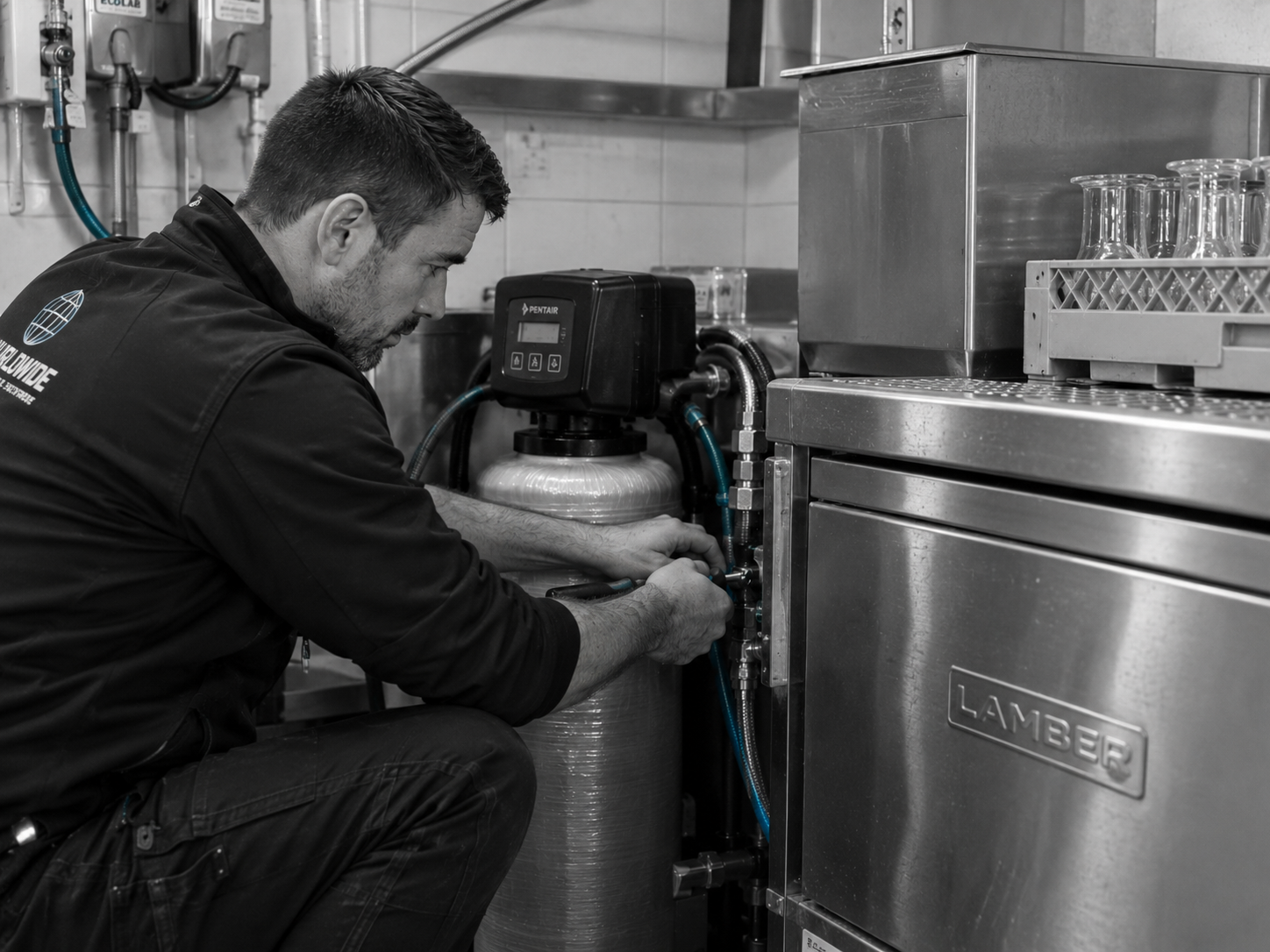
Commercial Glasswasher Water Softener Problems
Cloudy Glasses, White Marks or Scale That Keeps Coming Back?
The glasses used to come out clear.
Now they're cloudy.
White marks have started appearing.
Staff are polishing glasses after every cycle.
Scale keeps returning inside the machine.
You've adjusted the chemicals.
You've cleaned the glasswasher.
Maybe you've even descaled it.
But the problem keeps coming back.
Where a commercial glasswasher uses a water softener, the problem may not be the glasswasher itself.
Hard water may be reaching the machine because the water-softening system isn't operating as intended.
Worldwide CDM diagnoses commercial glasswasher water softener and related water-quality problems across Sydney.
With more than 30 years of commercial catering equipment experience, we investigate whether the problem is coming from the water softener, scale, chemical dosing, rinse performance or another part of the glasswashing process.
Stop Treating the Marks. Find Out What's Causing Them.
What Does a Commercial Glasswasher Water Softener Do?
Hard water contains dissolved minerals, particularly calcium and magnesium.
When mineral-containing water is repeatedly heated and used within commercial warewashing equipment, those minerals can contribute to deposits and scale.
A conventional ion-exchange water softener reduces water hardness before the treated water reaches the glasswasher.
Depending on the installation, the water softener may be:
Built into the glasswasher
Installed externally
Manually regenerated
Automatically regenerated
Not every commercial glasswasher has a water softener.
And importantly:
Having a Water Softener Doesn't Automatically Mean Your Water Is Being Softened Correctly.
The system needs to be appropriately sized, configured, regenerated and maintained for its particular application.
Signs of a Commercial Glasswasher Water Softener Problem
Possible signs can include:
Cloudy glasses
White mineral marks
Spots on glassware
Increasing scale inside the glasswasher
Scale around rinse jets
Scale around wash arms
Mineral deposits on heating surfaces
Increasing scale despite regular cleaning
Poor rinse results
Salt level not changing as expected
Unusually high salt consumption
Regeneration problems
Treated water remaining hard
Glasswashing results gradually deteriorating
Scale returning quickly after descaling
These symptoms may point towards a water-treatment problem.
But several other faults can produce similar results.
Don't Diagnose the Softener From the Glass Alone.
Why Does Hard Water Matter in a Commercial Glasswasher?
Glasswashing is particularly sensitive to water conditions because the finished glass is expected to be visibly clear.
Mineral-containing water can contribute to:
Spots
White deposits
Scale
Cloudy-looking glassware
Mineral accumulation inside equipment
Scale may also accumulate within parts of the glasswasher itself.
Depending on the machine, affected areas can include:
Heating surfaces
Rinse jets
Wash arms
Water pathways
Tank surfaces
Valves
Booster systems
Manufacturer troubleshooting guidance specifically identifies excessively hard water as a cause of calcification and recommends checking water softening and salt where applicable.
Water Quality Affects More Than How the Glass Looks.
Commercial Glasswasher Water Softener Not Working
A water softener needs to regenerate correctly to continue reducing hardness.
Depending on the type of system, possible problems can involve:
Insufficient salt
Incorrect salt
Regeneration not occurring
Incorrect regeneration settings
Salt-related problems
Valves
Water flow
Controls
Resin condition
Installation
Other system-specific faults
The first question should therefore be:
Is the Water Coming Out of the Softener Actually Soft?
That can be far more useful than assuming the system works simply because it contains salt.
Commercial Glasswasher Water Softener Salt Problems
Many ion-exchange water softeners use regenerating salt as part of the process that restores the softening capacity of the resin.
If the particular system requires salt and there isn't enough available for correct regeneration, softening performance can deteriorate.
Depending on the system, salt-related problems can include:
Salt level too low
Incorrect salt
Salt not being used
Salt bridging
Brine-system problems
Regeneration not occurring correctly
Follow the instructions for the specific water softener or glasswasher.
For example, some commercial glasswasher manufacturers specify dedicated water-softener salt rather than ordinary cooking salt.
Use the Salt Specified for Your Equipment.
Why Isn't My Glasswasher Water Softener Using Salt?
If the salt level never appears to change despite regular use, don't immediately assume everything is fine.
Depending on the system, unusually low or absent salt consumption may indicate that regeneration isn't occurring as expected.
However, salt consumption varies according to factors such as:
Water hardness
Water consumption
Softener capacity
Regeneration settings
Equipment design
Frequency of regeneration
So the salt level alone isn't enough to diagnose the system.
The better question is:
Is the Softener Successfully Reducing the Water Hardness?
Why Is My Water Softener Using Too Much Salt?
The opposite can also occur.
If salt consumption suddenly increases substantially, possible areas to consider include:
Regeneration frequency
Settings
Water usage
Incoming water hardness
Controls
Brine-system operation
Other softener-specific conditions
Higher salt consumption doesn't automatically mean the softener is working better.
If something has suddenly changed, investigate why.
Commercial Glasswasher Water Softener Regeneration Problems
Ion-exchange resin doesn't have unlimited softening capacity.
As hardness minerals are captured, the resin eventually needs to be regenerated.
The regeneration process restores its ability to continue softening water.
Depending on the system, regeneration may be:
Automatic
Timer controlled
Volume controlled
Cycle based
Manually initiated
Some commercial glasswashers with integrated softeners automatically or manually initiate regeneration after a specified number of operating cycles.
If regeneration doesn't occur correctly, hard water may eventually begin reaching the glasswasher again.
Manual Water Softener Regeneration Problems
Some commercial glasswasher systems require staff to initiate or manage regeneration.
That means correct operation partly depends on the venue.
Problems can occur when regeneration is:
Forgotten
Performed incorrectly
Performed too infrequently
Not matched to water usage
Not matched to incoming water hardness
If the glasswasher performed well previously but scale and marks have gradually returned, ask:
When Was the Water Softener Last Regenerated?
Staff training can be just as important as equipment condition with manually operated systems.
Automatic Water Softener Problems
Automatic regeneration reduces operator involvement.
But automatic doesn't mean fault-proof.
Depending on the system, problems may involve:
Programming
Regeneration settings
Valves
Controls
Water flow
Salt or brine system
Other equipment-specific components
A softener can appear perfectly normal from the outside while failing to deliver adequately softened water.
Test the Result, Not Just the Appearance of the Equipment.
Commercial Glasswasher Water Softener Resin Problems
Inside an ion-exchange softener is resin responsible for exchanging hardness ions.
Its effectiveness depends on the system operating under suitable conditions and regenerating correctly.
If treated water remains hard even though:
Salt is present
Regeneration appears to occur
Settings appear normal
the wider softening system may require investigation.
Don't automatically assume the resin requires replacement.
Other parts of the regeneration or water-treatment process should also be assessed.
How Do You Know if a Glasswasher Water Softener Is Working?
Test the Water.
One of the most useful ways to investigate a suspected water-softener problem is to assess water hardness.
Where appropriate, comparison can help establish:
Hardness of incoming water
Hardness after treatment
Whether the softener is reducing hardness
Whether hardness begins breaking through
Whether performance changes between regeneration cycles
This gives you actual information about the water rather than relying only on visible scale.
A softener full of salt isn't proof that the water leaving it is soft.
Measure First. Diagnose Second.
Why Are My Glasses Suddenly Cloudy?
Cloudy glasses are one of the most common reasons a venue suspects its water softener.
Hard-water minerals can contribute to deposits.
But cloudiness can also involve:
Detergent dosing
Rinse-aid dosing
Poor rinsing
Water temperature
Scale
Water quality
Glass condition
Permanent glass corrosion or etching
That distinction matters.
A water softener won't repair permanently damaged glassware.
And increasing chemical dosing won't necessarily remove a hard-water problem.
Same Appearance. Different Causes.
Glasses suddenly looking cloudy?
Troubleshoot Commercial Glasswasher Leaving Glasses Cloudy →
Why Is My Glasswasher Leaving White Marks?
White marks don't automatically mean:
"The water softener is broken."
Possible causes can include:
Hard-water mineral deposits
Chemical residue
Detergent concentration
Rinse-aid problems
Poor rinsing
Scale
Water-quality conditions
Look at what else is happening.
If white marks have appeared at the same time as rapidly increasing scale inside the machine, water hardness becomes particularly relevant.
If the machine itself remains relatively scale-free, investigate other possibilities too.
Diagnose the Deposit Before Treating It.
Scale Build-Up Inside a Commercial Glasswasher
Scale can develop where hardness minerals accumulate.
Inside a commercial glasswasher, mineral deposits may form around:
Heating components
Rinse jets
Wash arms
Tank surfaces
Water pathways
Valves
Booster components
This isn't only a cosmetic problem.
Heavy scale can restrict small water pathways and reduce heat transfer from heating surfaces.
Your existing glasswasher rinse troubleshooting also identifies scale around jets, arms and water pathways as a possible contributor to poor rinse performance.
Why Does Scale Keep Coming Back After Descaling?
This is an important question.
Imagine the glasswasher is heavily scaled.
It is descaled.
The visible mineral deposits disappear.
The problem appears fixed.
But the water softener isn't regenerating correctly.
Hard water continues entering the glasswasher.
Eventually:
The scale comes back.
The descaling process may have removed the existing deposits.
It simply didn't address why they formed.
Removing Scale and Preventing Scale Are Two Different Jobs.
Should I Just Descale the Glasswasher?
Not automatically.
Descaling may be appropriate when mineral deposits are actually present and the procedure is compatible with the particular equipment.
But descaling should not become the default response to every white mark or poor wash result.
And if scale keeps returning quickly, the underlying water conditions should be investigated.
Repeatedly removing the symptom while ignoring the water treatment can mean solving the same problem over and over again.
Don't Descale a Commercial Glasswasher Unnecessarily
More maintenance isn't automatically better maintenance.
If there is little or no scale inside the machine, an unnecessary descaling process adds cost without solving a real problem.
White marks on glasses could instead involve:
Chemicals
Rinsing
Water quality
Glass condition
Another operating problem
Use products and procedures appropriate for the equipment and follow relevant manufacturer requirements.
Inspect First. Service What's Actually Required.
Water Softener Problem or Chemical Dosing Problem?
These problems are easy to confuse.
Water Hardness Problems May Contribute To:
Mineral deposits
Scale
White marks
Cloudy glass appearance
Chemical Dosing Problems May Contribute To:
Film
Streaks
Residue
Poor drying
Poor cleaning
Excessive chemical consumption
And sometimes both issues exist at the same time.
Manufacturer chemical guidance also notes that chemical selection needs to be compatible with actual water hardness.
Don't Try to Fix Hard Water by Continually Increasing the Chemicals.
Chemical consumption changed too?
Troubleshoot Commercial Glasswasher Chemical Dosing Problems →
Water Softener Problem or Rinse Problem?
Poor glass finishing can also come from the rinse system.
Possible rinse-related problems can include:
Blocked rinse jets
Restricted rinse arms
Water-supply problems
Rinse pressure
Temperature
Valves
Pump-related problems
Scale
Chemical dosing
Hard water can also indirectly contribute to rinse problems if scale begins restricting rinse jets or other water pathways.
This means the softener and glasswasher sometimes need to be considered as one connected system.
Streaks or residue after rinsing?
Troubleshoot Commercial Glasswasher Not Rinsing Properly →
Water Softener Problem or Heating Problem?
Scale accumulation on heating surfaces can reduce heat transfer.
However, if your glasswasher isn't reaching temperature, don't immediately blame hard water.
Heating problems may also involve:
Heating elements
Thermostats
Sensors
Contactors
Relays
Controls
Water level
Electrical supply
If the machine has both heavy scale and a heating problem, the two may be related — but diagnosis is still required. Your existing heating page makes the same distinction.
Machine struggling to reach temperature?
Troubleshoot Commercial Glasswasher Not Heating →
Water Softener vs Reverse Osmosis
A water softener and reverse-osmosis system don't do exactly the same job.
A conventional ion-exchange softener primarily reduces hardness minerals such as calcium and magnesium.
Reverse osmosis removes a broader range of dissolved substances from water through membrane filtration.
This distinction can matter where a venue is pursuing particularly high-quality glass finishing.
Manufacturer guidance notes that where water quality itself is inadequate for glassware, more extensive treatment such as osmosis or demineralisation may sometimes be appropriate.
The appropriate water treatment depends on:
Incoming water quality
Equipment
Glassware
Required finish
Chemical system
Site conditions
Don't Assume Every Water-Quality Problem Needs the Same Treatment.
Has Something Recently Changed?
If the glasswasher produced clear glasses for months or years and suddenly doesn't, this is useful diagnostic information.
Ask whether anything changed around the same time.
For example:
Softener ran out of salt
Regeneration was missed
Staff changed
Chemical supplier changed
Detergent changed
Rinse aid changed
Softener settings changed
Machine was serviced
Plumbing work was completed
Water-treatment equipment was altered
Water usage increased
The timeline can help narrow down the cause.
What Staff Can Check Before Calling for Service
You don't need to dismantle the water softener.
A few observations can help.
Check the Salt
If your particular system requires regenerating salt, check the level and use the correct product specified for the equipment.
Check Regeneration
If regeneration requires operator action, confirm that it is actually being performed according to the equipment instructions.
Look Inside the Glasswasher
Is scale appearing around:
Tank surfaces?
Heating areas?
Wash arms?
Rinse jets?
Water pathways?
Look at the Glasses
Are they:
Cloudy?
White?
Spotted?
Streaked?
Covered in removable residue?
Think About When the Problem Started
Sudden changes are useful diagnostic clues.
Photograph the Problem
Photos of the glassware and visible scale can help explain what is happening.
Find the Brand and Model
Provide the glasswasher details and, if possible, information about the water-softening system.
What Not to Do
Don't:
Assume every white mark is scale
Keep increasing detergent to compensate for hard water
Keep increasing rinse aid without diagnosis
Use ordinary salt unless the equipment specifically permits it
Randomly change water-softener settings
Repeatedly descale without investigating why scale returns
Use unsuitable acids or chemicals
Assume salt in the reservoir proves the softener works
Treat the Cause — Not Just the Appearance of the Glass.
How We Diagnose Commercial Glasswasher Water Softener Problems
1. Tell Us What You're Seeing
Provide the glasswasher brand and model if known.
Tell us whether you're experiencing:
Cloudy glasses
White marks
Scale
Poor rinsing
Increased mineral deposits
Salt problems
Regeneration problems
Other changes in glasswashing performance
2. We Consider the Water Treatment and Glasswasher Together
Depending on the equipment and symptoms, diagnosis may involve consideration of relevant:
Incoming water hardness
Treated water hardness
Softener operation
Salt
Regeneration
Resin
Valves
Water flow
Controls
Scale accumulation
Wash system
Rinse system
Heating system
Chemical dosing
Other operating conditions
3. We Identify the Cause
The objective is to determine whether the problem comes from:
The water softener
The glasswasher
The chemical system
The incoming water
or
a combination of factors.
4. We Explain What We've Found
We'll explain what's contributing to the problem and what requires attention.
5. We Service or Repair What's Required
Where appropriate, the relevant equipment or glasswasher system can then be addressed.
We Find the Fault Before We Sell the Fix.
Why Correct Diagnosis Can Save You Money
Imagine cloudy glasses start appearing.
Staff increase rinse aid.
No improvement.
Then they increase detergent.
Still cloudy.
The glasswasher is descaled.
The glasses improve temporarily.
A few weeks later, the problem returns.
Why?
Because the water softener wasn't regenerating correctly.
Hard water continued entering the glasswasher.
In that situation, continually adjusting chemicals and removing scale is treating the downstream symptoms.
Find the Upstream Cause.
Commercial Glasswasher Water Softener Problems Across Sydney
Worldwide CDM provides commercial glasswasher fault diagnosis and servicing for:
Restaurants
Bars
Pubs
Clubs
Hotels
Cafés
Function centres
Catering businesses
Commercial kitchens
Hospitality venues
We service commercial customers throughout Sydney and surrounding service areas.
Commercial Glasswasher Brands We Repair
Worldwide CDM diagnoses and repairs faults across many commercial glasswasher brands used throughout Sydney hospitality venues, including:
Contact us with your glasswasher brand, model and a description of where the water is appearing.
More Than 30 Years of Commercial Equipment Experience
Your customers don't know whether your water softener regenerated last night.
They don't know how hard the incoming water is.
They don't know whether scale is beginning to restrict a rinse jet.
They simply see the glass placed in front of them.
Worldwide CDM is a family-run commercial catering equipment business with more than 30 years of experience supporting Sydney hospitality businesses.
Our approach is simple:
Look at the symptom.
Assess the water treatment.
Assess the glasswasher.
Identify the cause.
Service what's actually required.
We Find the Fault Before We Sell the Fix.
Keep Serving Customers With Confidence.
Related Commercial Glasswasher Problems
Commercial Glasswasher Leaving Glasses Cloudy
Cloudy or hazy glassware after washing?
Troubleshoot Commercial Glasswasher Leaving Glasses Cloudy →
Commercial Glasswasher Chemical Dosing Problems
Detergent or rinse-aid consumption has changed?
Troubleshoot Commercial Glasswasher Chemical Dosing Problems →
Commercial Glasswasher Not Rinsing Properly
Streaks, residue or poor finishing?
Troubleshoot Commercial Glasswasher Not Rinsing Properly →
Commercial Glasswasher Not Heating
Heavy scale appearing alongside temperature problems?
Troubleshoot Commercial Glasswasher Not Heating →
Commercial Glasswasher Pump Problems
Weak circulation, unusual pump noise or drainage problems?
Frequently Asked Questions
What does a commercial glasswasher water softener do?
A conventional ion-exchange water softener reduces calcium and magnesium hardness in incoming water. This can help reduce mineral deposits and scale reaching or forming within appropriate commercial glasswasher installations.
How do I know if my glasswasher water softener isn't working?
Possible signs include increasing scale, mineral deposits, cloudy or marked glassware and treated water remaining hard. Water-hardness testing and inspection may be required to confirm whether the softener is responsible.
Why are my glasses cloudy even though I have a water softener?
Cloudiness can involve hard-water deposits, chemical dosing, poor rinsing, scale, water quality or permanent glass damage. Having a water softener doesn't rule out these other causes.
Why is my commercial glasswasher leaving white marks?
White marks may involve mineral deposits, water hardness, detergent, rinse aid, poor rinsing or other water-quality conditions. The appearance alone doesn't confirm a water-softener fault.
Why isn't my glasswasher water softener using salt?
Salt consumption varies according to equipment, hardness, water usage and regeneration frequency. If salt consumption has unexpectedly stopped, regeneration or another part of the system may require investigation.
Why is my glasswasher water softener using too much salt?
Possible considerations include regeneration frequency, settings, water consumption, hardness and other system conditions. The correct consumption depends on the particular installation.
Does a commercial glasswasher water softener need regeneration?
Ion-exchange softeners require regeneration after their available softening capacity is used. How and when this occurs depends on the particular equipment.
Can hard water cause scale inside a commercial glasswasher?
Yes. Hardness minerals can contribute to scale when mineral-containing water is repeatedly heated and used within equipment.
Can scale affect glasswasher performance?
Significant scale can restrict water pathways and jets and affect heat transfer from heating surfaces, potentially contributing to other performance problems.
Will descaling fix a faulty water softener?
No. Descaling may remove existing mineral deposits, but it doesn't repair a water softener that isn't treating the incoming water correctly.
Should I increase rinse aid if my glasses are cloudy?
Not automatically. Cloudiness can have several causes, including mineral deposits, chemical conditions, poor rinsing and glass damage. Determine the cause before changing chemical settings.
Can I use normal table salt in my glasswasher water softener?
Use the regenerating salt specified by the equipment manufacturer. Some commercial glasswasher manufacturers specifically warn against using cooking salt.
Is reverse osmosis the same as a water softener?
No. Conventional ion-exchange softening primarily targets hardness minerals, while reverse osmosis uses membrane filtration to remove a broader range of dissolved substances.
Do all commercial glasswashers have water softeners?
No. Water-treatment arrangements vary between models and installations. Some have integrated softeners, some use external treatment and others may use different arrangements.
Do you diagnose commercial glasswasher water softener problems in Sydney?
Yes. Worldwide CDM can investigate water-treatment and related commercial glasswasher performance problems as part of commercial glasswasher servicing and fault diagnosis across Sydney.
Commercial Glasswasher Water Softener Problem?
Stop Polishing Around the Problem.
Cloudy glasses.
White marks.
Scale that keeps coming back.
Increasing the chemicals or repeatedly descaling the machine may treat the symptom without addressing why it keeps happening.
Worldwide CDM can investigate the water treatment and glasswasher systems to determine what's contributing to the problem.
30+ Years' Commercial Equipment Experience
Commercial Glasswasher Fault Diagnosis
Water-Related Fault Investigation
Sydney Service
Family Owned
Commercial Equipment Specialists
Straightforward Advice
Clearer Glasses. Better-Protected Equipment.
Keep Serving Customers With Confidence.
Click Here To Book A Service
Click Here To Call For Urgent Repairs
Related Commercial Catering Equipment Repairs
Worldwide CDM also provides professional repairs for: